

If you're looking up the best thermal paste for your CPU, there's a good chance your PC is giving you a reason. Maybe the fans are louder than they used to be. Maybe temperatures climbed after a few years. Maybe you're building a new system and don't want to redo the cooler later because of one messy little tube.
Thermal paste is one of those small parts that gets ignored until heat becomes a problem. Then people start chasing the highest conductivity number they can find. That's where a lot of bad buying decisions start. A paste can look impressive on the box and still be annoying to apply, unstable over time, or just overkill for the machine it's going into.
The smarter approach is to match the paste to the job. For some systems, that means strong all-round performance with easy application. For others, it means durability over years of thermal cycling. If your machine is already running hot, it's also worth checking common overheating causes in this guide on why a laptop may be overheating.
Table of Contents
- Why Your CPU Needs the Right Thermal Paste
- Decoding Thermal Paste Specs and Marketing Hype
- The 2026 Best Thermal Pastes by Use Case
- Choosing for Durability and Long-Term Stability
- How to Apply Thermal Paste Correctly
- When to Call a Pro On-Site Thermal Help in Edmonton
- Frequently Asked Questions About CPU Thermal Paste
Why Your CPU Needs the Right Thermal Paste
A CPU cooler doesn't work properly if it can't transfer heat cleanly from the processor into the heatsink. Even when the metal surfaces look flat, they still have tiny imperfections. Thermal paste fills those microscopic gaps so heat moves through the interface instead of getting trapped in pockets of air.
That matters more than people realise. Bad paste, dried paste, or poorly applied paste can lead to higher temperatures, louder fans, lower sustained boost clocks, and thermal throttling under load. The computer still turns on, so the problem often gets missed for months.
Most buying advice stops at conductivity numbers, and that's too simplistic. Data from a ranking focused on CPU paste performance notes that many guides overvalue W/mK alone and ignore the balance between thermal conductivity, durability, and application ease. In that same testing context, Carbon paste at 15.2 W/mK reached the lowest average delta temperature of 50.6°C while also standing out for long-term durability, which is why a balanced choice usually beats a flashy spec-sheet number for everyday ownership (termopasty CPU paste ranking).
What the paste is actually doing
Think of thermal paste as a gap filler, not a thick cooling layer. You want just enough to cover the surface inconsistencies once mounting pressure spreads it out. Too little leaves dry spots. Too much can create a mess and work against good contact.
Practical rule: The best thermal paste for CPU use isn't automatically the one with the highest quoted conductivity. It's the one that fits your cooler, your workload, and how long you want the repair to last.
In Edmonton, that distinction matters. Plenty of home users and small offices want a machine that stays stable through seasons, dust, and years of use. They're not trying to win a benchmark screenshot. They want the computer to stay cool and quiet without opening it up again anytime soon.
Decoding Thermal Paste Specs and Marketing Hype
Thermal paste packaging is full of numbers and technical terms, but only a few of them help you make a good decision. The problem isn't that the specs are useless. It's that manufacturers and sellers often present one number as if it tells the whole story.
Thermal conductivity in plain English
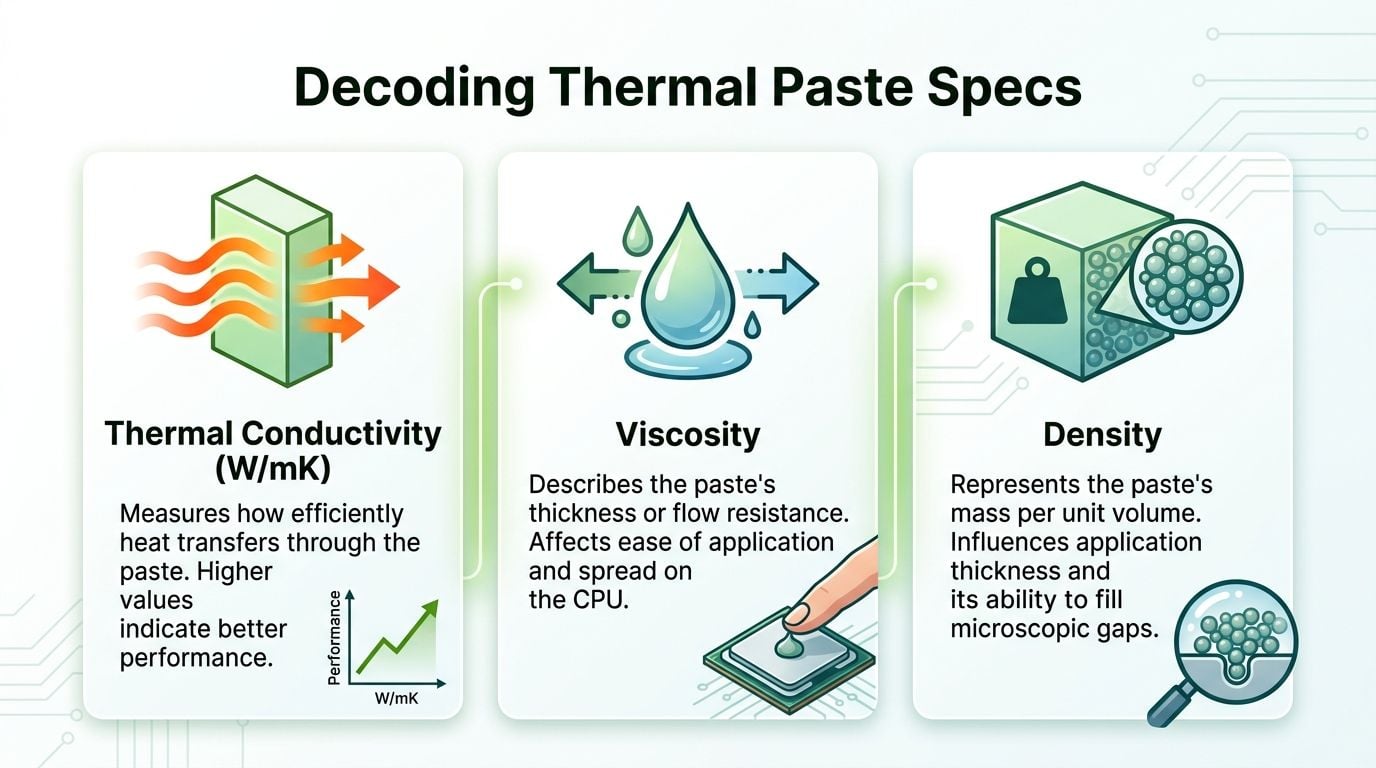
Thermal conductivity, usually shown as W/mK, tells you how efficiently a material can move heat. A higher number is generally better, but it isn't the only thing that matters in real use.
Tom's Hardware tested 90 different thermal pastes in 2025 and found that the top-performing products reached 15.2 W/mK, while standard pastes typically sat in the 8.0 to 12.0 W/mK range. In that testing, the highest-performing group also delivered the lowest average temperature delta of 50.6°C under load, which gives a useful benchmark for what premium compounds can do (Tom's Hardware thermal paste testing).
A good way to think about W/mK is as the width of a highway for heat. More lanes help, but traffic still depends on road quality, merges, and bottlenecks. With thermal paste, those bottlenecks are things like spread, density, mounting pressure, and how the compound ages.
Viscosity and density matter more than shoppers expect
Viscosity tells you how thick the paste is and how easily it moves when you apply pressure. Some compounds spread nicely under a cooler. Others are stiffer and require a bit more care. A thick paste isn't bad by default, but it can be less forgiving for first-time builders.
Density affects how the material fills tiny surface gaps and how it behaves once clamped between the CPU and cooler. That's part of why two products with similar conductivity ratings can perform differently once installed.
Here's a practical way to read a spec sheet:
- Start with conductivity: A higher figure can indicate stronger thermal transfer potential.
- Check usability: If the paste is known for awkward spread or messy handling, that matters.
- Think about lifespan: A compound that performs well on day one but dries or pumps out quickly isn't a great value.
- Match the use case: A gaming desktop, office tower, and thin laptop don't always benefit from the same paste characteristics.
Good thermal results come from the whole interface. Paste, pressure, cooler flatness, and cleanliness all affect the final outcome.
What counts as marketing fluff
Any thermal paste that leans too hard on one headline number deserves a second look. Some compounds look excellent in theory but are difficult to apply consistently. Others make sense only for experienced users or highly specific hardware.
Generally, the best thermal paste for CPU cooling is the one that gives dependable temperatures without turning installation into a precision experiment. That usually means buying from known product lines, choosing a paste with a reputation for consistent spread, and avoiding anything that sounds impressive but lacks practical context.
The 2026 Best Thermal Pastes by Use Case
A Ryzen 7 gaming build, a quiet office tower, and a laptop that already runs hot should not all get the same paste recommendation. The right pick is the one that balances cooling performance, staying power, and ease of application for that specific machine. If you only shop by the biggest W/mK number on the package, it is easy to buy a paste that looks impressive but is annoying to use or less stable over time.

Quick comparison table
| Product | Best For | Conductivity (W/mK) | Key Feature |
|---|---|---|---|
| Arctic MX-6 | Most users | Above 12.5 W/mK | Strong all-round performance and stable temperatures |
| Thermal Grizzly Kryonaut | Enthusiasts and high-TDP CPUs | Qualitatively high-performing | Very low thermal resistance with precise application |
| Carbon-based premium paste | Long-term reliability focus | 15.2 W/mK | Top benchmark performance with durability emphasis |
| Mid-range paste in the 12.5 to 12.8 range | Mainstream desktops | 12.5 to 12.8 W/mK | Balanced cost and efficiency |
| Ceramic filler paste | Set-and-forget systems | Qualitatively durability-focused | Better long-term stability in demanding uptime scenarios |
Best all-round pick
Arctic MX-6 is the easy recommendation for the majority of desktop builds. It performs well enough for modern gaming CPUs, it is not overly fussy to work with, and it suits the kind of repaste jobs people do once and then do not want to revisit for a while.
A user discussion on PC Master Race describes MX-6 delivering solid idle and load temperatures in normal desktop use (PC Master Race discussion of Arctic MX-6). I would not treat forum posts as lab testing, but they are useful for one thing. They show whether a paste behaves predictably in real systems, with real builders, under ordinary mounting pressure.
Why MX-6 works for so many builds:
- Strong enough thermal performance: It is in the range most builders want for current desktop CPUs.
- Good handling: It is easier to place and clamp down than some thinner or more temperamental compounds.
- Low-risk choice: It fits gaming PCs, office desktops, and routine cooler replacements without much drama.
If a client wants one tube for a new build and future maintenance, this is usually the first paste I mention.
Best for overclocking and high-TDP chips
Thermal Grizzly Kryonaut still earns a place for enthusiasts chasing lower temperatures on hotter processors. Its appeal is simple. It can shave off a bit more thermal resistance than safer all-purpose compounds, but that small gain usually depends on clean surfaces, even mounting pressure, and the right amount of paste.
That trade-off matters more than the brand name. A paste aimed at enthusiasts can outperform a mainstream option, but it can also punish a rushed install. On an overclocked Intel i7 or Ryzen 9, a few degrees of improvement may be worth the extra care. On a stock office PC, it usually is not.
Use Kryonaut if you are comfortable pulling the cooler back off and correcting the mount if temperatures are not where they should be.
Best for set-and-forget reliability
Some systems need consistency more than peak benchmark numbers. That includes business desktops, home office machines, family PCs, and any workstation that is costly or annoying to service again.
For those builds, carbon-based and ceramic-oriented compounds deserve serious attention. Carbon-heavy premium pastes can offer very good thermal performance while still being practical to apply. Ceramic-focused products are often chosen for their steadier long-term behaviour, especially in systems that stay on for long periods or see regular heat cycling.
That makes them a sensible fit for managed fleets and uptime-focused environments. Teams planning broader IT maintenance strategies for businesses usually benefit more from predictable service intervals than from chasing the last degree in a fresh benchmark.
Best for compact systems and laptops
Laptops and small form factor builds are less forgiving. Contact areas are smaller, heatsinks can be awkward to remove, and one bad application often means taking the whole thing apart again.
For these systems, I usually look for three things:
- Controlled spread: The paste should stay where you place it.
- Clean handling: Less mess matters around tight board layouts and small components.
- Stable service life: A good laptop repaste should last, because reopening the machine is often the worst part of the job.
In practice, that often makes a well-behaved mainstream or durability-focused paste a better choice than an extreme enthusiast compound. The absolute top performer on a test bench is not always the smartest option inside a thin laptop.
Nerds 2 You doesn't provide remote services. Nerds 2 You doesn't provide full MSP services but does provide ongoing support and network monitoring for small and medium businesses.
Choosing for Durability and Long-Term Stability
A paste that posts nice temperatures on install day can still be the wrong choice if it degrades quickly. This is the part most buyers skip. They compare conductivity, ignore composition, and end up reopening the machine earlier than they expected.
Why longevity matters more than many buyers think
Thermal paste lives in a rough environment. It sits between two surfaces that heat up and cool down repeatedly. Over time, some compounds dry out, some separate, and some shift away from the hottest contact area. That movement is often called pump-out.
Long-term stability testing shows a major gap between filler types. Thermal pastes with ceramic fillers maintain 98% of their initial thermal performance after 12 months of continuous operation at 70°C, while organic filler pastes can degrade by as much as 35% (stability testing on filler performance).
That kind of difference matters in machines that stay on for long hours, get moved around, or run warm every day.
Which paste types make sense for most people
For the average desktop owner, I'd rank priorities like this:
- First, stability: You want a compound that won't dry out quickly.
- Then application ease: A forgiving paste reduces installation errors.
- Finally, peak thermal edge: This matters most for enthusiasts and heavy sustained loads.
If you maintain office systems or shared workstations, this mindset lines up well with broader IT maintenance strategies for businesses. Preventive work usually beats emergency fixes, and thermal upkeep fits that same logic.
A stable paste often saves more trouble than a slightly faster one. Reopening a machine, cleaning the old compound, and remounting the cooler is where the real cost usually shows up.
Ceramic-filled options are especially appealing for systems that need predictable long-term behaviour. Carbon-based compounds can also make sense when you want top-tier thermal performance without leaning into more specialised and riskier materials. For many Edmonton homes and small businesses, reliability wins.
How to Apply Thermal Paste Correctly
A good paste choice can still give poor temperatures if the install is messy. In the shop, I see the same failure points over and over. Old compound left behind, too much paste, uneven cooler pressure, or a laptop full of dust that was never addressed while the system was open.
Prep work that prevents bad results
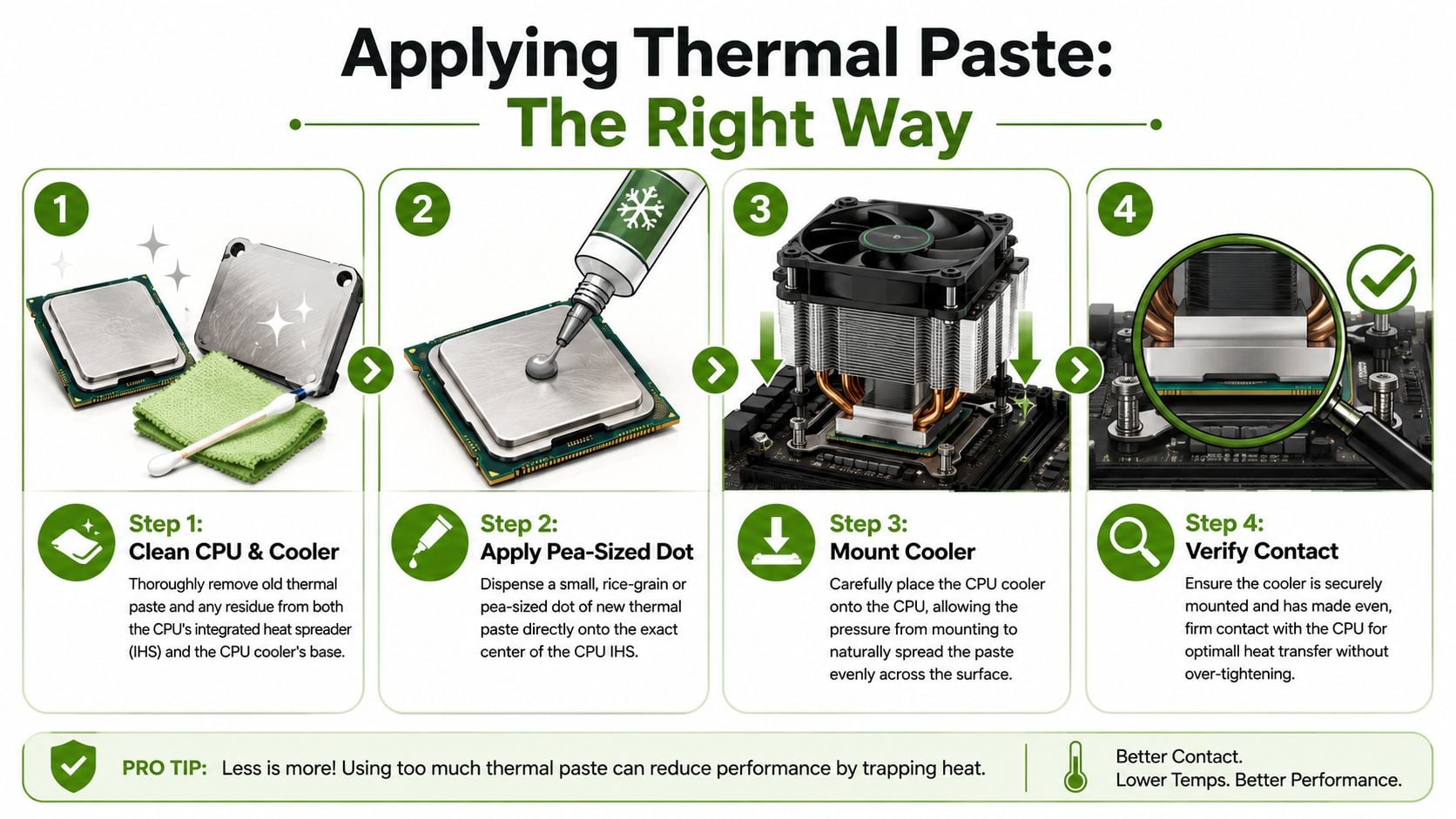
Start with clean contact surfaces. Remove the old paste from both the CPU heat spreader and the cooler base with a lint-free cloth or coffee filter and a suitable cleaner, then let both surfaces dry fully. Any residue, fibres, or skin oil can interfere with contact.
If you are opening a laptop, handle dust and airflow at the same time. A fresh paste job will not fix a heatsink packed with lint or fan blades coated in grime. If you need a walkthrough, this guide on how to clean laptop fans fits well with a repaste.
Use this checklist before the new compound goes on:
- Shut down and unplug the system: Let it cool before you touch the cooler.
- Remove the heatsink carefully: A slight twist helps if the old paste has stuck.
- Clean both mating surfaces: Leave no old paste, dust, or fibres behind.
- Check the mounting hardware: Bent brackets or loose standoffs can ruin contact pressure.
Application methods that work in the real world
For most desktop CPUs, a small center dot is the safest method. Cooler pressure spreads the paste on its own, which keeps the layer thin and reduces the odds of trapping air or making a mess around the socket.
Other patterns can make sense depending on the chip and cooler:
- Pea-sized dot: Best for many mainstream desktop CPUs.
- Short line: Useful on larger heat spreaders where the contact area is wider.
- Multiple small dots: Sometimes used on very large CPUs, but easier to overapply.
The exact pattern matters less than clean surfaces, the right amount, and even mounting pressure. More paste does not mean better cooling. Thermal paste fills microscopic gaps. It is not supposed to act as a thick layer between the CPU and cooler.
Use enough to fill imperfections, not enough to create a blanket.
Once the cooler is in place, tighten it evenly in the proper pattern for that mount. Alternate corners if the design allows it, and bring pressure up gradually instead of fully tightening one side first. If you lift the cooler to inspect the spread, plan to clean both surfaces and apply fresh paste again.
If temperatures still look high after a repaste, check the full thermal path before blaming the compound. Confirm the fan curve, cooler seating, case airflow, dust levels, and whether the cooler is strong enough for that CPU under sustained load. That balance matters more than chasing the highest conductivity number on the box.
When to Call a Pro On-Site Thermal Help in Edmonton
Applying thermal paste isn't the hardest PC task, but it isn't risk-free either. On a standard desktop, many people can handle it themselves. On a high-value gaming rig, a tightly packed laptop, or a machine with awkward mounting hardware, getting help can be the smarter call.

A few situations usually justify on-site support:
- Laptop repasting: Internal layouts are tighter and easier to damage.
- Thermal issues with unknown cause: The paste may not be the primary problem.
- Work computers: Downtime matters more than the DIY experience.
- High-end custom builds: A mistake is more expensive than the service.
For Edmonton users who want someone to handle diagnosis, cleaning, and repasting on location, it helps to understand what on-site computer repair includes. That's especially useful when the machine also needs fan cleaning, airflow checks, or a broader thermal inspection.
Professional help isn't a fallback for people who “can't do it.” It's often the practical choice when the system is valuable, the machine is fragile, or you want the cooler remounted properly the first time.
Frequently Asked Questions About CPU Thermal Paste
Can you reuse thermal paste
No. Once the cooler has been removed, the old paste should be cleaned off and replaced. Reusing it can leave gaps, uneven spread, or dried sections that don't transfer heat properly.
Is thermal paste the same as a thermal pad
No. Thermal paste is meant for very thin contact between surfaces like a CPU and cooler. Thermal pads are used where a designed gap needs to be filled, often on memory chips or power components. They are not interchangeable in every situation.
How often should thermal paste be replaced
There isn't one schedule that fits every PC. A desktop with stable temperatures may go a long time without needing fresh paste. A hotter gaming system, a laptop, or a machine showing rising fan noise and temperatures may need attention sooner.
What's the safest pick for most users
An easy-to-apply, non-fussy paste with a good reputation for stability is usually the safest choice. For most builders, the best thermal paste for CPU work is the one that balances cooling, durability, and application ease rather than chasing extreme specs.
If your desktop or laptop is running hot and you'd rather have someone handle the diagnosis and repaste on-site, Nerds 2 You Edmonton provides mobile computer repair across Edmonton for home users and businesses.
Contact Nerds 2 You for quality professional service
Experience the difference with our dedicated team of experts ready to assist you. Whether you need immediate support or have questions about our services, we are here to help. Reach out today and let us provide you with the reliable service you deserve. Your satisfaction is our priority and we guarantee a prompt response to all inquiries.
Discover more from Nerds 2 You
Subscribe to get the latest posts sent to your email.