

Your screen freezes right as you hit save. The Wi-Fi drops when your meeting starts. The printer suddenly vanishes from the network five minutes before you need boarding passes, invoices, or school forms. Individuals generally don't need personal computer help on a quiet Saturday afternoon when nothing matters. They require it when work is due, family photos matter, or the whole house is asking why the internet isn't working.
That stress is normal. Computers fail in ordinary, annoying, badly timed ways. In Edmonton, they're part of daily life for work, school, banking, streaming, and staying in touch. Specific data on personal computer help demand in Alberta shows that over 60% of Edmonton households own at least one computer, and approximately 35% report needing technical assistance annually for issues like virus removal, hardware upgrades, or network setup according to Statista's PC market coverage.
Good help isn't about making technology sound complicated. It's about narrowing the problem, fixing what can be fixed quickly, and recognising when an on-site technician will save you time, money, and frustration.
Table of Contents
- That Moment When Your Computer Gives Up
- Simple PC Triage Steps You Can Try Right Now
- Knowing When to Call a Professional Technician
- On-Site Support Versus Other Repair Options
- Your Edmonton Solution Nerds 2 You
- What to Expect During Your Service Visit
- Edmonton PC Help FAQs
That Moment When Your Computer Gives Up
A lot of calls start the same way. Someone was finishing payroll, helping a child submit homework, or trying to join a video appointment, and then the computer stopped responding. The mouse still moved, but nothing opened. Or the laptop restarted over and over. Or the internet worked on a phone but not on the desktop.

That moment feels bigger than a machine problem because the computer is tied to everything else. It holds the document, the email account, the tax files, the Zoom login, the family photos, and the browser tabs you needed open right now. When it fails, the day can grind to a stop.
What people usually see first
The first symptom often isn't dramatic. It's subtle.
- Sudden slowness: Programs take forever to open, and typing lags behind your fingers.
- Repeated restarts: The computer boots, flashes a logo, and starts over again.
- No connection: Wi-Fi shows as connected, but websites don't load and cloud files won't sync.
- Strange warnings: Pop-ups push fake scans, expired protection notices, or urgent calls to action.
Most computer problems don't begin with smoke or a loud bang. They begin with one small thing that keeps happening until you can't ignore it.
If your machine keeps rebooting, a plain-English guide on resolving PC restart loops can help you recognise whether you're dealing with a software hiccup, a failing update, or something deeper.
Why this happens at the worst time
People notice tech issues under pressure because pressure exposes weak spots. A laptop that barely copes with everyday browsing may freeze once you open email, Word, accounting software, and a video call at the same time. A weak home network may seem fine until everyone is online at once. An aging hard drive can limp along for weeks, then stall when you need one file immediately.
That doesn't mean you're careless. It means your computer is part of real life, and real life isn't gentle on devices.
Simple PC Triage Steps You Can Try Right Now
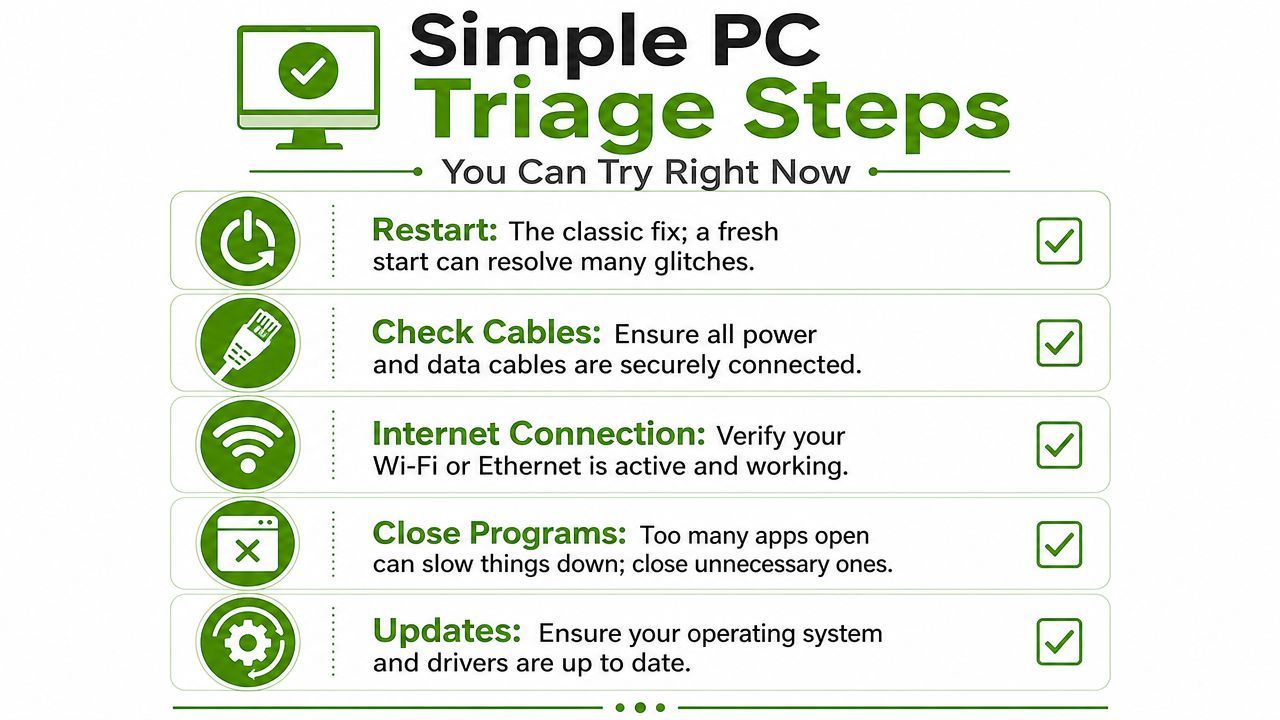
Before you assume the computer is dying, do a quick triage. This is comparable to checking whether a car is out of fuel before calling for an engine rebuild. Small faults cause a surprising number of big-looking problems.
Start with the obvious physical checks
A desktop that "won't turn on" sometimes has a loose power bar switch. A monitor that looks dead may be on the wrong input. A laptop that won't charge may have a power adapter that's only half seated.
Run through these first:
-
Power connection
Unplug the charger or power cable, then reconnect it firmly at both ends. If you're using a power bar, make sure it's on. -
Monitor and display
If the computer seems to run but the screen is black, check brightness, monitor power, and cable seating. On a desktop, look for whether the monitor cable is plugged into the correct video port. -
Keyboard, mouse, and USB devices
Disconnect unnecessary accessories. Faulty USB devices can cause strange startup issues.
Restart properly, not endlessly
A restart helps because it clears temporary software conflicts and stuck background tasks. But there is a difference between one clean restart and repeatedly forcing the machine off without waiting.
- If Windows or macOS still responds, use the normal restart option.
- If it's frozen, hold the power button until it shuts down, wait a moment, then start it again.
- If it keeps failing the same way, stop after one or two attempts and pay attention to what changed.
That last point matters. Did the issue begin after an update, after installing a printer, after downloading something, or after moving the computer to a different room? The timeline often gives away the cause.
Practical rule: If a restart fixes the issue once but the problem keeps coming back, the restart wasn't the repair. It was only a symptom reset.
Check whether the problem is the computer or the internet
People often blame the PC when the network is the actual problem. Test with purpose.
- Try another website: If one service fails but others load, the internet may be fine.
- Test another device: If your phone also struggles on Wi-Fi, the issue is probably with the network.
- Switch connection type if possible: Move from Wi-Fi to Ethernet, or briefly test with a hotspot to isolate the fault.
Remote workers and home users dealing with sluggish systems can also work through these slow computer simple fixes to speed it up before booking a visit.
Close clutter and look for warning signs
Open too many browser tabs, cloud sync tools, and background apps, and even a decent PC can crawl. Close what you don't need. Then watch for patterns.
A few signs matter more than people realise:
- The fan runs constantly even with light use.
- Pop-ups appear when no browser is open.
- Storage is nearly full, which can make updates and apps misbehave.
- The machine is unusually hot on the bottom or near the vents.
Run built-in updates and scans
If the computer is still responsive, update the operating system and let the built-in security tools scan the machine. Out-of-date systems often act unstable in ways that look like hardware failure.
Don't install three different "cleaner" apps because a search result told you to. That's one of the fastest ways to turn a manageable problem into a mess.
Knowing When to Call a Professional Technician
Some issues are safe to poke at. Others aren't. The trick is knowing where the line is.
Signs that usually mean stop troubleshooting
A few symptoms are strong indicators that home troubleshooting has done its job and it's time to hand it over.
-
The computer won't power on at all
If you've checked the power source and still get nothing, the fault may involve the power supply, motherboard, charging circuit, or internal damage. -
You hear clicking, grinding, or repeated mechanical noises
Those sounds can point to drive failure. Continued use can reduce the chance of recovering files. -
You get repeated crash screens or startup failures
One error after an update is one thing. The same failure every boot is different. -
Liquid was spilled on the device
Turning it back on too soon can make things worse. -
Malware keeps coming back
If pop-ups, redirects, or fake alerts survive basic cleanup, the system needs a deeper inspection.
If your computer contains anything you can't replace, family photos, tax records, work files, don't keep experimenting once the signs point to hardware trouble.
Why DIY can backfire
The main risk isn't just breaking something. It's losing data, damaging connectors, stripping screws, cracking clips, or making the original fault harder to diagnose. Laptop internals are compact. Modern machines often hide the problem behind similar symptoms. A failing SSD, corrupted Windows profile, bad RAM stick, and overheating issue can all look like "my computer is slow and crashes."
That's why clear diagnosis matters more than random fixes. Reinstalling Windows might seem decisive, but if the drive itself is failing, you've only added stress to a weak component. Replacing parts without testing can also waste money.
When you've reached that point, a personal computer specialist can narrow the issue properly and tell you whether the sensible next step is repair, recovery, upgrade, or replacement.
A simple decision test
Ask yourself three questions:
| Question | If the answer is yes |
|---|---|
| Is the problem getting worse, not better? | Stop trial-and-error fixes |
| Could I lose important files if I keep using it? | Prioritise diagnosis and backup |
| Am I guessing now instead of testing? | Call a technician |
If you can answer yes to even one, it's usually time.
On-Site Support Versus Other Repair Options
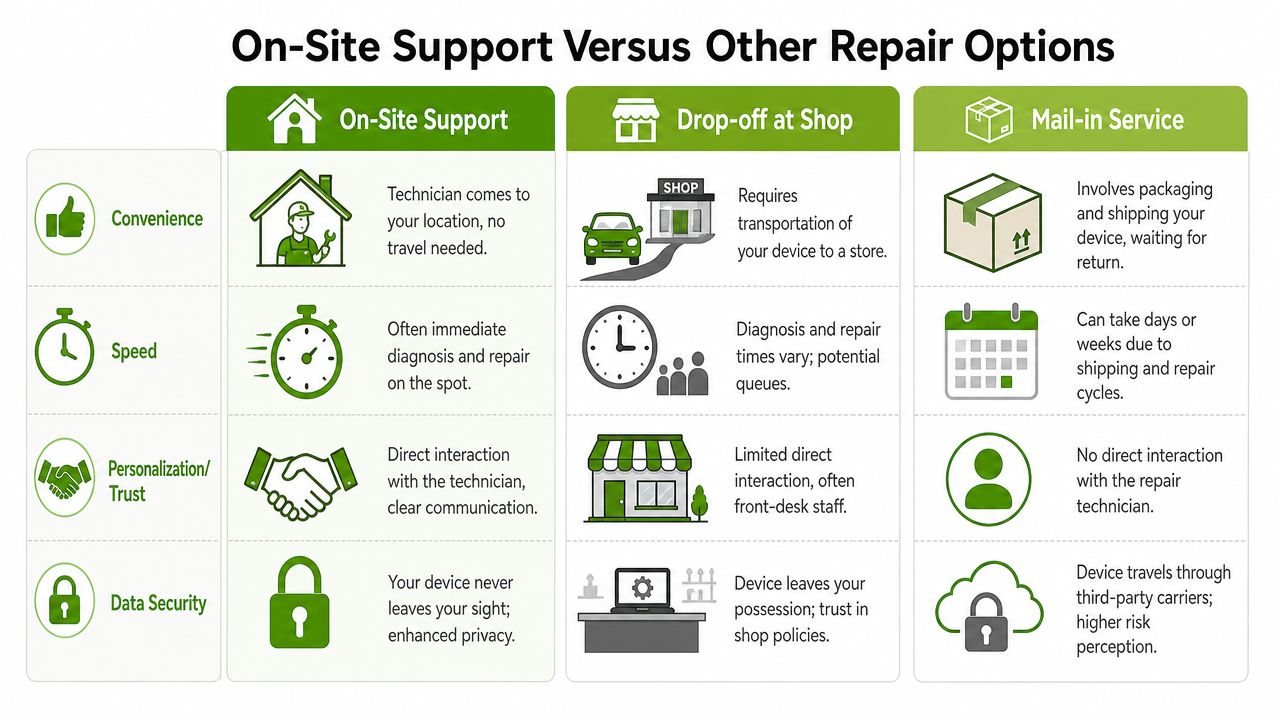
Once you've decided you need help, the next question is where that help should happen. In practice, the options often boil down to on-site support, drop-off repair, and mail-in service.
Why on-site support changes the whole experience
A home or office setup is rarely just one computer. It's the desktop, the printer, the Wi-Fi, the modem, the spare laptop, the monitor on the dining table, the email account on the phone, and the password the browser saved years ago. Remove the PC from that environment and you remove half the clues.
On-site work lets a technician see the actual setup. That's important when the issue involves intermittent Wi-Fi drops, a printer that only fails from one room, a desktop that won't connect to a specific monitor, or a smart home device interfering with the network. Those problems often don't show up the same way on a repair bench.
The trade-offs side by side
| Repair option | What works well | What doesn't work well |
|---|---|---|
| On-site support | Real-world diagnosis, face-to-face communication, no need to disconnect everything | Not every board-level issue can be completed in one visit |
| Drop-off at shop | Useful for certain longer bench repairs | You have to unplug, transport, and reconnect the whole setup yourself |
| Mail-in service | Can suit niche repairs when location doesn't matter | Slower, less personal, and your device is out of your hands longer |
The more your problem depends on your network, peripherals, or how the device behaves in your space, the more on-site service makes sense.
Why some Edmonton businesses prefer local, on-site help
For business users, support style affects trust as much as speed. SMBs in Alberta that use on-site-only IT support services report a 32% higher customer satisfaction rate than those using full remote MSP services, with 89% citing transparency and fair pricing as key factors, according to 2025 data from the Alberta Chamber of Commerce in this BBB business profile reference.
That lines up with what many owners already know. They want someone to look at the office router, the staff workstations, and the printer cabinet in person. They don't want to explain the layout three times to a call centre. They also don't want to grant broad remote access if they can avoid it.
If you want a closer look at what that approach includes, this overview of what on-site computer repair includes is useful.
Your Edmonton Solution Nerds 2 You
Good local computer help should match the way people in Edmonton use their devices. A home office setup has different failure points than a family desktop in the kitchen. A senior may need patient, in-person help with email safety and backups. A small business may need someone who can troubleshoot a workstation, check the router, and keep an eye on the network without pushing them into a full managed services contract.
What local on-site help should actually cover
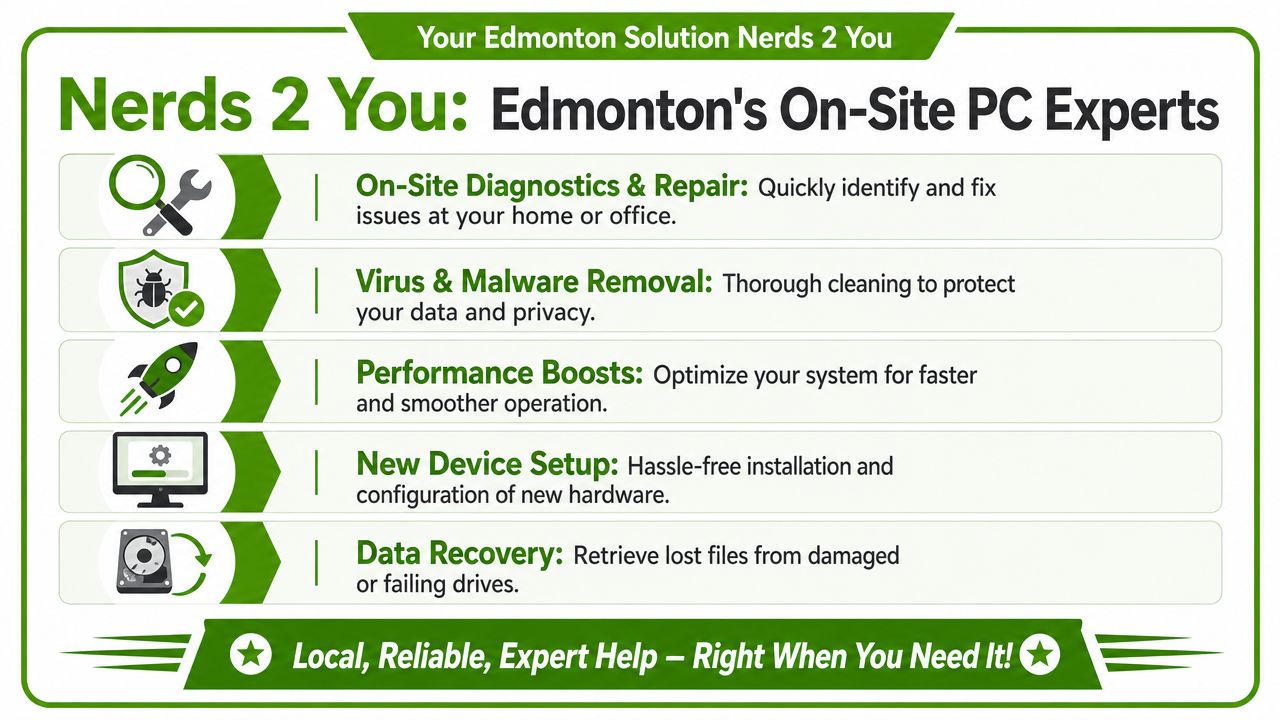
A useful service should solve the common problems that happen in homes and small offices, including:
- Diagnostics and repair: finding out whether the issue comes from software, hardware, power, storage, or the surrounding network
- Virus and malware cleanup: removing infections and checking what settings, files, or browser behaviour changed
- Performance work: cleaning up startup load, dealing with low storage, and improving everyday speed
- New system setup: configuring email, printers, data transfer, and user accounts so the computer is ready to use
- Network support: fixing weak Wi-Fi, guest network issues, and devices that refuse to stay connected
For business owners, ongoing support often matters as much as the repair itself. The goal is fewer interruptions, clearer advice, and a technician who understands how the office is set up.
Where Nerds 2 You fits
Nerds 2 You is a local mobile computer repair and IT support service that works on-site with PCs and Macs in homes and small businesses. The service focuses on in-person support rather than remote-only sessions. It also supports small and medium businesses with ongoing help and network monitoring, without requiring a full MSP arrangement.
That approach suits Edmonton clients who want a technician to see the whole setup in person. If the problem involves the modem, printer, cabling, wireless coverage, or how several devices interact, on-site service usually gets to the answer faster than a call centre script or a bench repair estimate.
A better fit for Edmonton homes and small offices
This model tends to make the most sense for:
- Home users who would rather not disconnect and haul in a desktop, monitor, and printer for a basic diagnosis
- Remote workers who need the computer, Wi-Fi, webcam, and printer checked together
- Small businesses that want continuity and network oversight without signing up for a full MSP structure
- Mac and PC households that need mixed devices to work together properly
- Seniors who benefit from calm, face-to-face guidance instead of a rushed remote session
Local support is not the cheapest option for every problem, and it is not meant to be. It is the better fit when context matters, when the setup around the computer is part of the issue, and when you want clear answers from someone who can stand in front of the problem and fix it where it happens.
What to Expect During Your Service Visit
A service visit should feel organised, not mysterious. The process is usually straightforward when the technician communicates clearly.
Before the appointment
The first step is describing the symptoms in plain English. You don't need technical language. "It freezes after login," "the printer disappeared," and "the Wi-Fi fails during meetings" are all useful starting points. Good notes help too. If you remember when the issue started, what changed, or whether there was a spill, update, or power outage, say so.
Scheduling matters for households and offices that can't pause the day. Nerds 2 You is open Monday to Friday 8:00 am to 8:00 pm and Saturdays 10:00 am to 6:00 pm, which gives people options outside a standard workday.
During the visit
Expect the technician to ask a few clarifying questions, observe the setup, and reproduce the problem if possible. That part is important. A fault seen in person is easier to explain and easier to fix than a second-hand description over the phone.
You should also expect plain language. A good technician won't hide behind jargon. If the issue is a weak power adapter, a failing drive, an overloaded startup list, or a network conflict, you should hear that in terms you can follow.
Clear service means you know what was found, what can be repaired now, what should wait, and what the trade-offs are.
Before any work moves ahead
You should get a clear explanation of the recommended fix before larger work begins. Sometimes the answer is repair. Sometimes it's not. If a machine is too old, too unstable, or too costly to revive sensibly, the honest answer may be to back it up and replace it.
That kind of transparency matters more than a fast sales pitch. Personal computer help is at its best when you understand your options and stay in control of the decision.
Edmonton PC Help FAQs
A lot of support calls sound simple at first. Then you see the setup in person and the root problem shows up. A weak Wi-Fi signal in one room, a printer that only fails on one laptop, or a PC that acts up after sleep mode are easier to sort out on-site than through a call centre script.
Frequently Asked Questions
| Question | Answer |
|---|---|
| Can a technician help if the problem is only happening on my home Wi-Fi? | Yes. That is a strong case for on-site help. Wi-Fi problems often depend on router placement, wall interference, device congestion, printer connections, or a dead spot in one part of the house. Those details are hard to judge remotely and impossible to see in a shop. |
| Is on-site service better for seniors? | Often, yes. In-person, step-by-step guidance is especially helpful for seniors who prefer a patient, hands-on approach to learning and troubleshooting instead of remote instructions. |
| What if my computer works sometimes and fails sometimes? | Intermittent faults are common. Write down when the problem happens, what programs were open, and whether it shows up at startup, during video calls, or after sleep mode. A pattern usually points the technician in the right direction faster. |
| Should I keep using a noisy computer until it fully dies? | No. Clicking, grinding, overheating, or repeated startup trouble can point to a failing drive, fan, or power issue. Continued use can turn a repairable problem into file loss. |
| Do I need to unplug everything before an on-site visit? | Usually not. Leaving everything connected often helps because the issue can be tested in the exact environment where it happens. |
| Can help include accessories, not just the computer itself? | Yes. Mice, keyboards, printers, webcams, monitors, and docking stations are often part of the real problem. If you are replacing accessories, a practical gaming mouse buying guide can help you compare grip styles and features before you buy. |
| What if I only need help learning the computer, not repairing it? | That is still a valid reason to book service. Plenty of people need help with setup, passwords, email safety, backups, software basics, or connecting devices correctly. |
The common thread behind most calls
People usually want three things. They want the computer working again, their files protected, and an explanation that makes sense.
That is where local Edmonton support stands out from big-box counters and remote-only help. A local technician can see the room, test the devices together, and explain the trade-offs on the spot. If the problem is simple, it gets fixed with ease. If the PC is failing and replacement makes more sense than repair, you hear that plainly.
Nerds 2 You handles the kind of home and small business issues that often need that in-person view, especially when the computer problem is tied to Wi-Fi, printers, accessories, or the way the whole setup works together.
Contact Nerds 2 You for quality professional service
Experience the difference with our dedicated team of experts ready to assist you. Whether you need immediate support or have questions about our services, we are here to help. Reach out today and let us provide you with the reliable service you deserve. Your satisfaction is our priority and we guarantee a prompt response to all inquiries.
Discover more from Nerds 2 You
Subscribe to get the latest posts sent to your email.