
It's 4 p.m. in Edmonton, the daylight has already thinned out, and your screen suddenly feels too bright, too dull, and too reflective at the same time. The lamp you ignored in summer is now throwing shadows across your keyboard, and the window behind you is turning every video call into a silhouette contest. That's the moment when you realise lighting for home office work needs more than one bulb.
A good setup isn't about making the room “brighter”. It's about giving each part of the room a job, so your eyes aren't fighting glare, shadows, and contrast all day. A practical plan uses layered light, a few placement rules, and the right colour temperature for the time of day. If you want a visual starting point while you work through the details, a useful home office lighting guide can help you compare ideas against your own room, and if you're also thinking about how your desk setup affects posture, the standing desk benefits page is a sensible companion read.
Table of Contents
- Why Lighting for Home Office Setups Deserves a Real Plan
- Understanding Ambient, Task, and Accent Lighting
- Recommended Illuminance and Colour Temperature Targets
- Placement Rules That Prevent Screen Glare and Shadows
- Choosing Bulbs and Fixtures Without Wasting Money
- Smart Lighting, Circadian Rhythms, and When to Call a Tech
- Quick Measurement and Troubleshooting Tips
- Putting Your Layered Lighting Plan Together
Why Lighting for Home Office Setups Deserves a Real Plan
At the end of a short winter day, bad lighting doesn't just look annoying, it changes how hard your eyes have to work. When the room goes dim but the monitor stays bright, or when the ceiling light throws a reflection across the screen, your brain keeps rebalancing contrast instead of settling into work. That's why a home office can feel tiring even when the chair, desk, and laptop all seem fine.
A room with one light source is usually the problem
A single overhead fixture can't handle all the jobs a home office asks for. It has to support reading, typing, video calls, and moving around the room, while daylight keeps changing in the background. In a place like Edmonton, that matters even more in winter, because you can't rely on steady sunlight to carry the day.
The fix is a layered plan. Ambient light fills the room, task light supports the desk, and accent light adds depth so the room doesn't feel flat or cave-like. If that sounds like a lot, it's really just a way of matching the light to the task instead of expecting one fixture to do everything.
Practical rule: if you notice glare first, fix placement. If you notice darkness first, fix ambient light. If you notice fatigue, check contrast between the desk, screen, and background.
For a deeper visual walk-through, the home office lighting guide is a good reference point, but the practical test is simpler. Sit at your desk, look at the screen, then look at the wall behind it. If the screen feels like the only bright object in the room, the setup needs layering.
Understanding Ambient, Task, and Accent Lighting
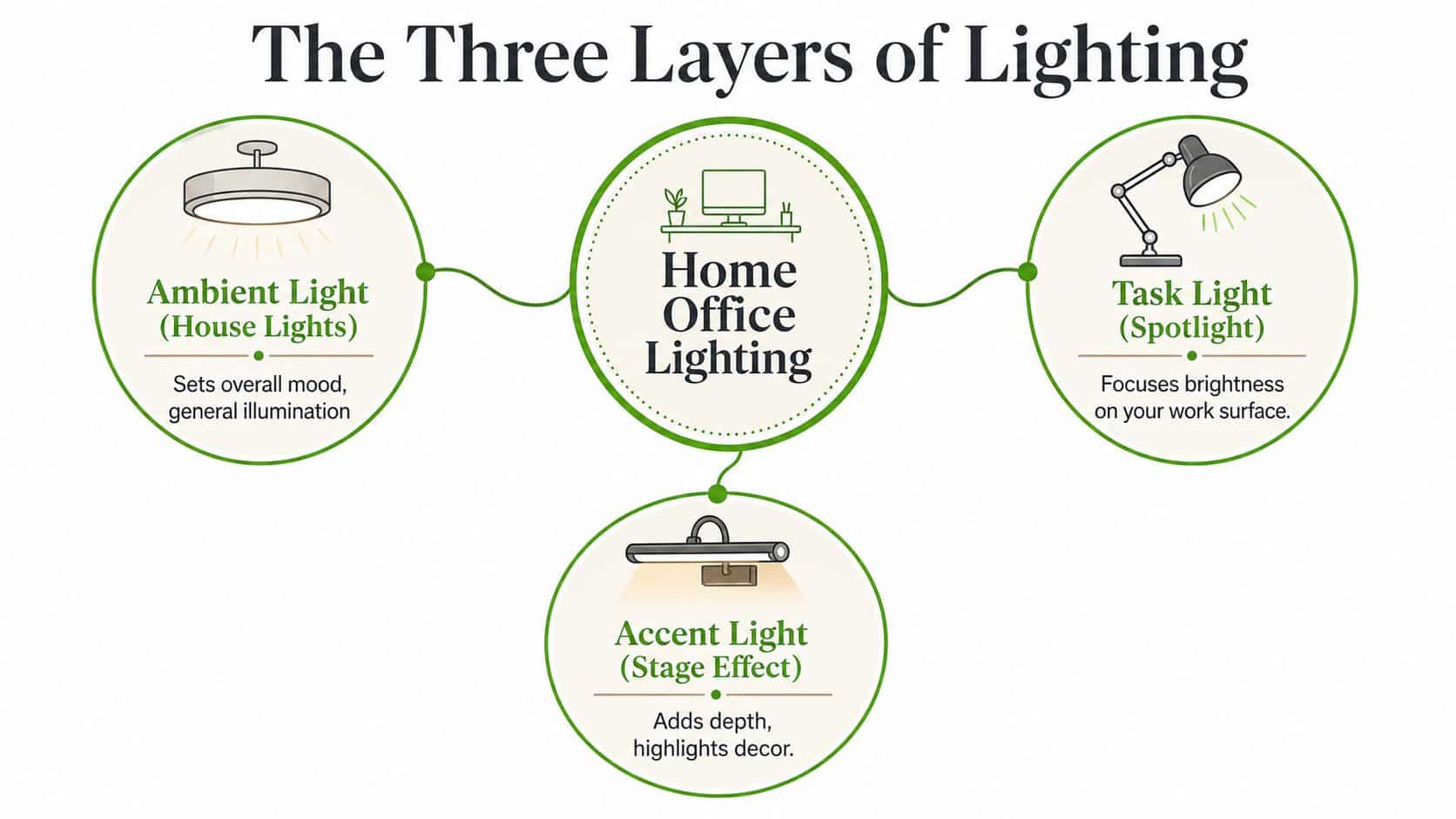
Think of home office lighting like stage lighting in a small theatre. The room needs house lights, a spotlight, and a little scenery light so the whole scene looks balanced. If any one layer is missing, the space starts feeling harsh, flat, or oddly gloomy.
Ambient light sets the room's baseline
Ambient light is the general light that lets you move around and stops the room from feeling like a cave. It usually comes from ceiling fixtures, floor lamps, or daylight washing in from a window. Without it, the task lamp has to do too much, and the room around you drops into shadow.
Task light handles the work surface
Task light is the focused light aimed at the desk. It makes reading, writing, and paper work easier without flooding the whole room. The key benchmark here is about 500 lux at desk level for sustained computer-based work, often paired with 4000K light for focused daytime tasks, according to lighting guidance for home offices and desk work remote work lighting guidance.
Accent light adds depth and reduces the flat look
Accent light is the extra layer that brightens a shelf, a wall, or the space behind you. It isn't there to be the main light. It gives the room shape, which helps reduce the “screen floating in a dark box” feeling that people often notice late in the day.
Daylight acts like a fourth layer, but it changes hour by hour. On bright days it can do part of the ambient job, and on cloudy days or in the winter it can vanish quickly. That's why a home office works better when daylight is treated as a free bonus, not the foundation.
Recommended Illuminance and Colour Temperature Targets
The easiest numbers to remember are the ones that match how the room feels. For a focused desk setup, 400 to 500 lux on the work surface is a sensible target, and Canadian federal office-lighting guidance from the National Research Council recommends that same range for desk working surfaces, with a 1.5 to 2:1 luminance ratio between the desktop and the background National Research Council office lighting guidance. That ratio matters because a bright desk inside a very dark room forces constant visual adjustment.
How to think about colour temperature without jargon
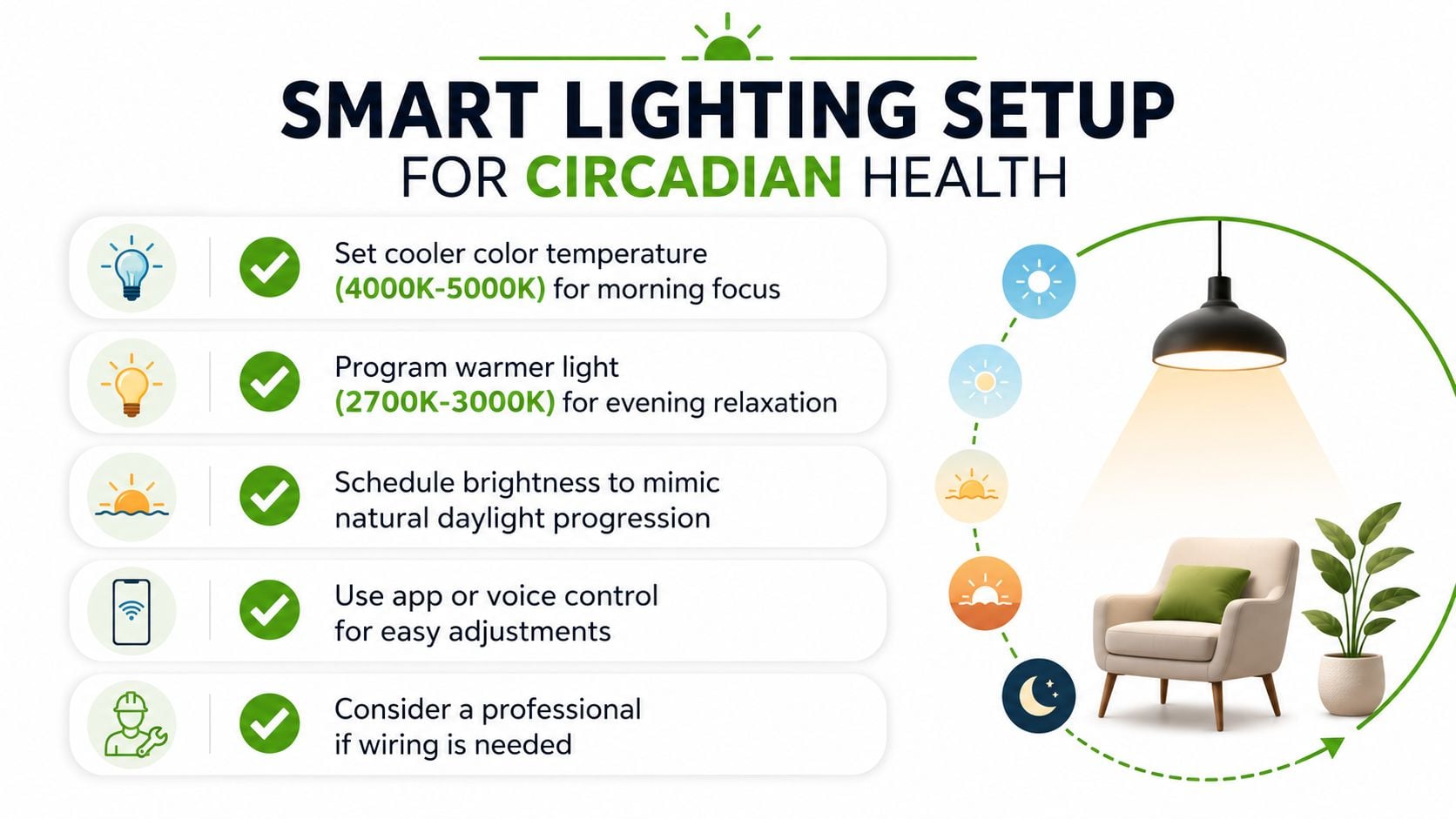
A 4000K bulb is often described as neutral-cool or daylight white. It feels clean and clear for daytime work without looking harsh like a very blue lamp. For evening work, a warmer range around 2700K to 3000K feels softer and less alerting, which is better when you're winding down after your last call.
The ceiling or room light should not outshine the desk by a huge margin. A layered approach often uses a 1:3:10 brightness ratio across ceiling, background walls, and the task area, so if your desk is around 500 lx, the walls sit near 150 lx and the ceiling at least 50 lx office lighting ratios. That stops the desk from looking like a spotlight in a dark auditorium.
Practical rule: if the desk feels bright but the room feels dim, your eyes still have work to do. Bring the background up before you add more desk light.
For a quick measurement conversion reference, the lighting design reference guide is useful when you're comparing product labels. A simple way to size the room is also to think in lumens, because modern home office guides recommend at least 100 lumens per square foot, which works out to about 1,000 lumens for a typical 10×10-foot room home office lighting setup guide.
| Lighting Targets for a Home Office | Illuminance Target | Colour Temperature | Why It Matters |
|---|---|---|---|
| Ambient room light | Around 50 to 150 lx | 2700K to 4000K | Keeps the room visually comfortable and reduces harsh contrast |
| Desk task light | 400 to 500 lx | 4000K in the day, warmer later | Supports reading, writing, and screen work without overlighting the monitor area |
| Background light | About 150 lx | 2700K to 3000K | Lifts the wall behind you so video calls and screen use feel less stark |
Placement Rules That Prevent Screen Glare and Shadows
The best lighting position is usually not the brightest one, it's the one that leaves your screen alone. If your light source is in front of the monitor, behind you, or aimed straight at the glass, you'll see reflections before you notice the actual brightness. That's why desk placement and lamp placement matter just as much as the bulb.
Start with the window, then place the desk
The desk should sit perpendicular to the window whenever possible, so daylight comes from the side instead of blasting straight into your eyes or the monitor. If the window is behind you, your face can end up too bright for the camera, and if the window is in front of you, the screen can wash out. Guidance aimed at home offices recommends placing the desk toward a window, adding a backlight, and lighting the background so video calls show a clear face rather than a silhouette video-call home office lighting advice.
Put the task lamp off-axis from the screen
A desk lamp works best when it sits to one side of the monitor, not directly facing it. A simple clock-face rule helps here. If the monitor is at 12 o'clock, put the lamp around 9 or 10 o'clock for a right-handed person, or 2 or 3 o'clock for a left-handed person, so the light lands on the desk without throwing a bright reflection across the display.
For window control, the office building window shade solutions page is a useful reminder that blinds, shades, and diffusers are often the cheapest glare fix in the room. You don't need blackout conditions, you just need to soften the light enough that the monitor stays readable.
If you can see your lamp reflected in the screen while you're working, the lamp is placed wrong.
A useful video-call add-on is a soft light behind or slightly beside you, plus some light on the wall or shelves behind the chair. That helps your face separate from the background. If the room looks flat on camera, it usually needs background light, not more brightness at the desk.
For a related maintenance habit, the cleaning laptop screen page is a smart reminder that dust and smudges can exaggerate glare and make a decent lighting setup look worse than it is.
Choosing Bulbs and Fixtures Without Wasting Money
LEDs make the most sense for home office use because they run cooler, last longer, and are easier to shape into focused light. Modern home-office guides note that LEDs can last up to 25 times longer than incandescent bulbs home office lighting setup guide, which matters when a bulb sits above a desk or behind a monitor and isn't fun to change.
Match the fixture to the job
A desk lamp with an adjustable arm gives you the most control over task light. A monitor light bar sits on top of the screen and keeps the desk clear, which is helpful if your workspace is cramped. A floor lamp can fill the room with ambient light, and a ceiling fixture can provide the base layer for the whole office.
The wrong buy is usually the cheapest bulb that says “daylight” on the box. It may still flicker, distort colours, or feel too sharp at close range. That becomes obvious on video calls, where skin tones and backgrounds can look odd if the light quality is poor.
Compare the common bulb choices
| Type | Strength in a home office | Main drawback |
|---|---|---|
| LED | Runs cool, lasts a long time, comes in many colour temperatures | Cheap versions can still flicker or render colours badly |
| CFL | Better than old incandescent bulbs for efficiency | Can feel slower to warm up and is less flexible for focused desk use |
| Incandescent | Familiar warm look and decent colour appearance | Produces more heat and needs replacing much more often |
For room sizing, a practical guide points to at least 100 lumens per square foot, or about 1,000 lumens for a typical 10×10-foot office home office lighting setup guide. That number doesn't mean one lamp has to do all the work. It means the room as a whole needs enough light, spread in a controlled way.
The lighting design reference guide is helpful if you're comparing lamp labels and trying to understand what the packaging is telling you. For a quick setup, one strong task lamp, one ambient source, and one small accent source are more effective than one oversized ceiling light.
Smart Lighting, Circadian Rhythms, and When to Call a Tech
Colour temperature isn't just about looks, it also changes how the room feels over the day. Cooler light is better suited to morning focus because it feels clearer and more alerting, while warmer light helps the workspace feel calmer later in the day. Smart bulbs and dimmers make that shift easier because you don't have to remember to change the setup manually.
Automate the light so you don't have to manage it all day
A sensible smart routine is simple. Use cooler light during focused work, then shift to warmer light as the day winds down. A schedule can also dim the room gradually, which makes the transition out of work feel less abrupt than turning everything off at once.
A smart bulb can be useful, but it's not the whole answer if the wiring or control setup is messy. If you need a new circuit, a smart switch, or integration with a home network, that's the point where outside help saves time. A local service such as smart light bulbs with Google Home can be a practical fit when the goal is getting the lighting controls to talk to the rest of your workspace.
Nerds 2 You does not provide remote services, and while not a full MSP, it does provide ongoing support and network monitoring for small and medium businesses Nerds 2 You. For a home office, that matters most when the lighting, Wi-Fi, and device setup need to work together instead of acting like separate projects.
Best line to remember: smart lighting should reduce friction, not add another app you hate using.
If you only need a bulb change or a dimmer schedule, you can handle that yourself. If you're opening walls, replacing switches, or tying smart lighting into an existing network, use an on-site technician.
Quick Measurement and Troubleshooting Tips
A five-minute check can tell you more than guessing ever will. Use a free lux meter app on your phone, put it on the desk surface, and compare the reading to the 500 lux desk target for focused work remote work lighting guidance. The number won't be laboratory-perfect, but it will show whether the room is obviously too dim or too bright.
A fast check that catches most problems
Hold your hand between the lamp and the desk. If it throws a hard shadow across the work surface, the lamp is probably too close, too narrow, or aimed too directly. If the shadow disappears but the desk still feels dull, ambient light is probably missing.
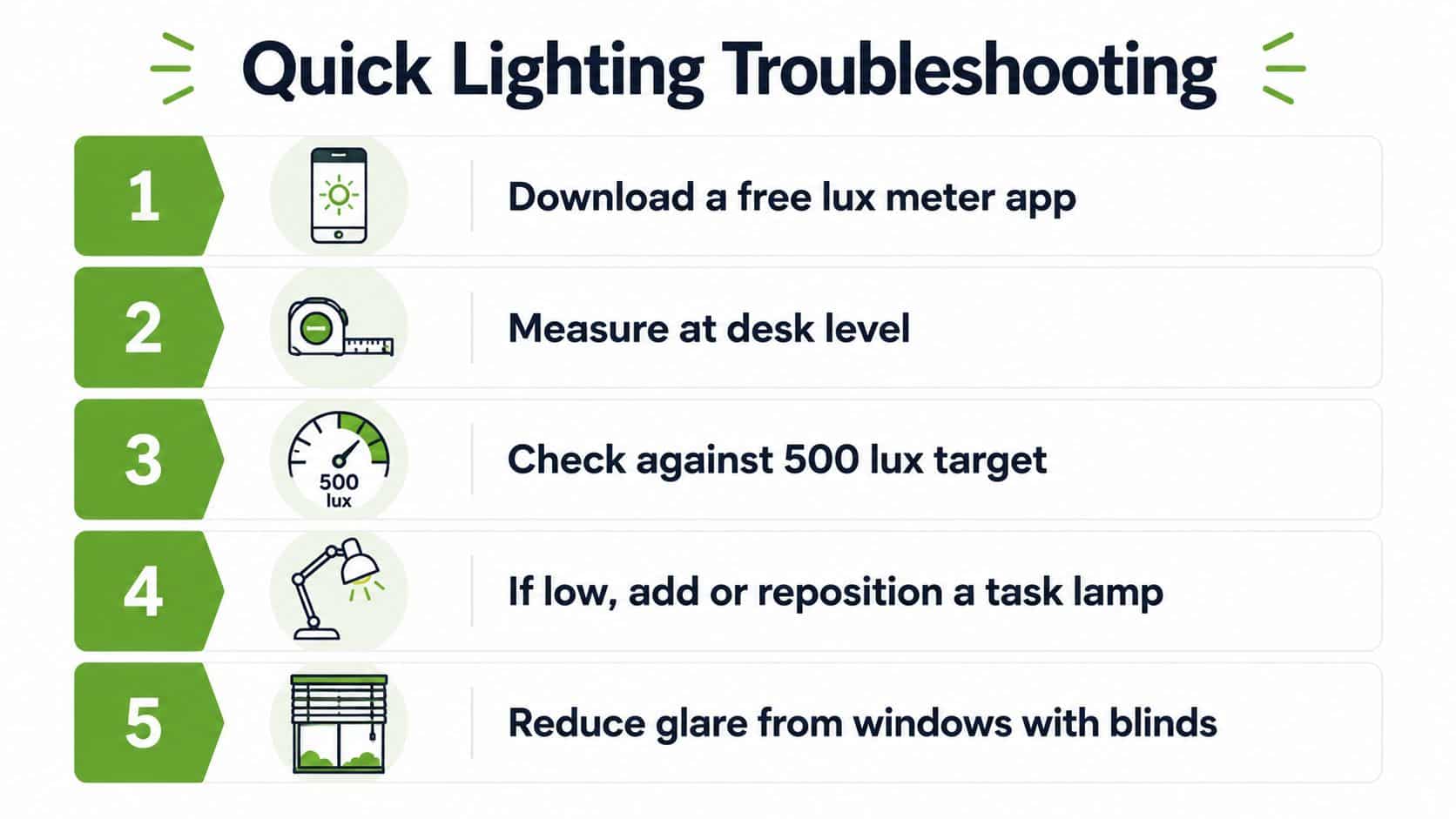
If the screen glare is the complaint, move the monitor so it sits perpendicular to the window and shift the lamp off to the side. If headaches show up by mid-afternoon, increase ambient light before you add more desk brightness. If video calls look washed out, add light to your face and the background, not just the keyboard. If cloudy-day work feels gloomy, bring in a floor lamp or raise the wall light so the room doesn't collapse into shadow.
For a related setup check, the cleaning laptop screen page is worth using when you're trying to tell the difference between real glare and a dirty display. A smudged screen can make a decent lighting plan look worse than it is.
Putting Your Layered Lighting Plan Together
A good home office usually needs four things working together. First, an ambient ceiling or floor light that gives the room a stable base. Second, a 4000K task lamp or monitor light bar at the desk. Third, a bit of accent light on a wall, shelf, or behind the monitor. Fourth, some kind of window control so daylight helps during the day instead of overpowering the screen.
That is why a single bright ceiling fixture is not a lighting plan. It might make the room look technically lit, but it won't solve glare, screen contrast, or camera lighting. A layered setup gives you a way to fix the exact thing that feels off instead of turning one switch and hoping for the best.
A simple checklist to keep nearby looks like this. Ambient light on. Task light aimed from the side. Window glare softened. Face lit for calls. Background not left in the dark. If your desk still feels harsh after that, the next move is usually placement, not more brightness.
When you're ready to turn a rough desk area into a comfortable workspace, use the plan above and test one change at a time. If you want help with the wider home office setup, including network, smart device, or workstation support, visit Nerds 2 You Edmonton to see how on-site help can fit into the rest of your remote work space.
Contact Nerds 2 You for quality professional service
Experience the difference with our dedicated team of experts ready to assist you. Whether you need immediate support or have questions about our services, we are here to help. Reach out today and let us provide you with the reliable service you deserve. Your satisfaction is our priority and we guarantee a prompt response to all inquiries.
Discover more from Nerds 2 You
Subscribe to get the latest posts sent to your email.