
Sedentary time adds up fast. A large review in JAMA found that higher daily sitting time was linked with a greater risk of death from all causes, especially when exercise levels were low. That helps explain why a standing desk gets attention in offices and home workspaces. It changes the pattern of your day, not just the height of your keyboard.
A standing desk works like a reset button for desk posture. Instead of staying in one fixed position for hours, you can shift between sitting and standing before stiffness builds in your neck, shoulders, hips, and lower back. That pattern matters for Edmonton workers who spend long winter stretches indoors, where a spare-room office or compact business setup can become an all-day sitting routine.
The practical benefit is flexibility. A height-adjustable desk can support short standing intervals during email, calls, data entry, or admin work, then return to a seated position for detailed tasks. For home workers, that may mean fitting a desk near a window to reduce glare during darker months and keeping cords clear of baseboard heaters. For a small Edmonton office, it can mean checking floor space, monitor depth, and outlet placement before delivery so staff can switch positions without crowding walkways or straining cables.
Good results depend on setup, not just the desk itself.
That is where local on-site help makes a difference. Nerds 2 You supports Edmonton homes and small offices with in-person tech and workspace guidance, which is useful when a desk change also affects monitor arms, docking stations, cable routing, Wi-Fi placement, printers, and multi-device layouts. The company does not provide remote services, and it does not offer full MSP coverage, but it does provide ongoing support and network monitoring for small and medium businesses.
A standing desk also works better when paired with movement habits. Short position changes, a properly placed screen, and simple posture exercises for office workers can help your body adapt without trading one strain for another. That broader approach is why many people use standing desks as one practical tool for combatting sedentary living effectively.
Table of Contents
- 1. Reduced Back and Neck Pain Through Better Posture
- 2. Increased Energy and Mental Alertness
- 3. Improved Calorie Expenditure and Weight Management
- 4. Enhanced Productivity and Task Focus
- 5. Reduced Risk of Chronic Disease and Mortality
- 6. Better Circulation and Reduced Varicose Vein Risk
- 7. Improved Mood, Motivation, and Reduced Depression Risk
- 8. Optimal Ergonomic Setup for Extended Computer Use
- 8-Point Comparison: Standing Desk Benefits
- Standing Up for Better Workdays
1. Reduced Back and Neck Pain Through Better Posture
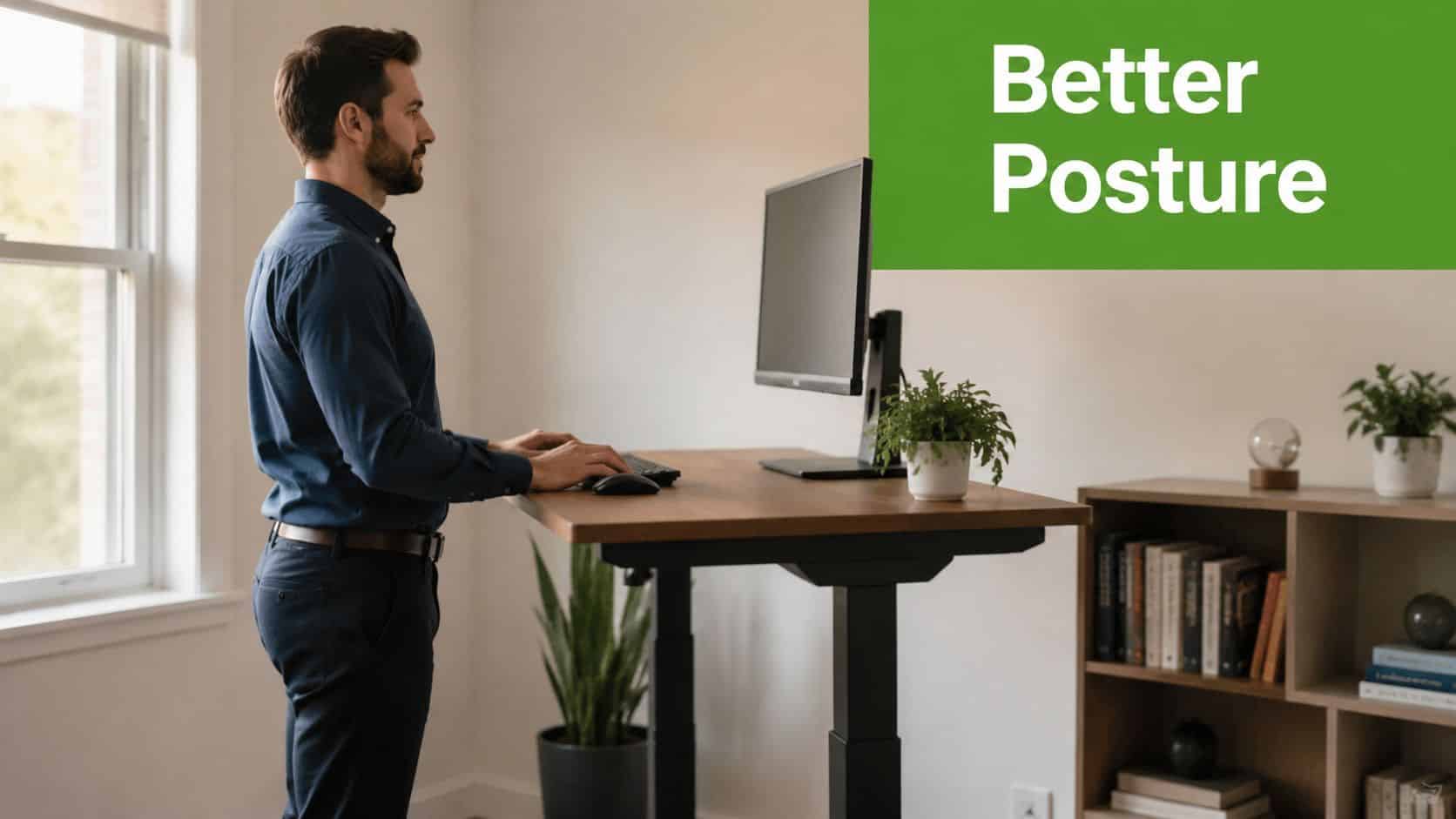
Back and neck pain often starts with a simple mismatch. Your body stays in one position, but your screen, keyboard, and desk height ask your joints to work at awkward angles for hours. A standing desk helps correct that mismatch by making it easier to bring your work to your body instead of bending your body toward your work.
That distinction matters. Researchers behind the CDC-backed Take-a-Stand Project summary published by Texas A&M reported that employees using sit-stand workstations saw meaningful reductions in upper back and neck discomfort over time. The benefit was not magic. It came from better positioning and more movement during the day.
Better posture starts with alignment, not just standing
Standing alone does not fix posture. If your monitor is too low, you will still drop your chin. If your keyboard is too high, your shoulders will still creep upward. A standing desk works like an adjustable frame around your workday. It gives you more chances to line up the screen, hands, shoulders, and feet so your muscles do less compensating.
Start with this order:
- Set the desk so your elbows rest close to a 90-degree angle.
- Raise the monitor so the top of the screen sits around eye level.
- Place the keyboard and mouse close enough that you do not reach forward.
- Stand with both feet planted and your weight evenly shared.
That sequence prevents a common mistake. Many home workers in Edmonton raise the laptop first, then leave the keyboard attached, which lifts the screen but forces the wrists and shoulders into a strained position.
A practical Edmonton setup example
A remote worker in southwest Edmonton using a dining table often runs into the same chain reaction. The table is too high for relaxed shoulders, the laptop screen is too low for the neck, and the chair usually is not built for full workdays. Add a desk converter, an external keyboard, and a separate monitor or laptop riser, and the posture chain improves from top to bottom.
Small offices across Edmonton run into a different version of the same issue. Front-desk staff, bookkeepers, and customer service teams may share workstations that were set once and never adjusted again. In those cases, on-site help matters because cable length, monitor arm placement, docking stations, and desk depth all affect whether the final setup is functional. Nerds 2 You can help with workstation performance optimization and desk-area hardware setup so the computer layout supports the ergonomic changes instead of working against them.
Small adjustments reduce strain faster than big intentions
Use these checks during setup:
- Elbows: Keep them near your sides, not winged outward.
- Wrists: Stay as straight as possible while typing.
- Screen distance: Place the monitor about an arm's length away.
- Feet: Use an anti-fatigue mat if you stand on hard flooring.
- Shoes: Supportive indoor shoes usually feel better than socks on laminate or tile.
- Schedule: Alternate between sitting and standing instead of trying to stand all day.
For many people, the fastest relief comes from reducing static posture, not from forcing a perfect pose. Your body tolerates moderate movement better than frozen stillness.
If your neck and shoulders already feel tight, pair the desk changes with short mobility breaks and simple posture exercises for office workers. That combination works well for Edmonton home offices and small business setups because it addresses both sides of the problem. Better equipment positioning, and a body that is not stuck in the same angle all day.
2. Increased Energy and Mental Alertness

A short position change can reset attention the way opening a window can refresh a warm room. The room is still the same, but it feels easier to think inside it. That is why many home workers and small office staff notice better alertness before they notice any other standing desk benefit.
Researchers behind a review published in the International Journal of Environmental Research and Public Health found that sit-stand workstations can improve feelings of energy and reduce fatigue in office settings. That does not mean standing turns every afternoon into a high-performance sprint. It means breaking up long sitting periods may help your brain feel less dulled by sameness.
Why alertness often improves
Your body reads long, still sitting as low-demand time. Standing changes that signal a little. You shift your weight, use your leg muscles lightly, and make more small adjustments without thinking about them. Those tiny movements work like background activity on a computer. Small, constant processes keep the system responsive.
For screen-heavy work, that change in rhythm matters. An Edmonton bookkeeper reconciling accounts, a designer reviewing proofs, or a remote software worker checking code can use short standing blocks for tasks that need sharper attention. Many people find planning, editing, reviewing, and email sorting easier while standing than long-form work that requires staying fixed in one position for an hour or more.
Standing tends to help best when the goal is alert attention, not all-day endurance.
That distinction prevents a common mistake. Some people raise the desk at 8 a.m. and try to stay there until lunch. By 10:30, their feet are tired, their shoulders creep up, and the benefit disappears. A better approach is to treat standing like intervals, not a marathon.
Here is a practical pattern that works well in Edmonton homes and small offices:
- Start with 20 to 30 minutes: Use one or two standing blocks in the morning, when mental energy is usually higher.
- Match standing to task type: Stand for calls, calendar planning, document review, and inbox cleanup.
- Sit for detail-heavy output: Switch back to sitting for long writing sessions or spreadsheet work that needs steadier arm support.
- Add light movement: Calf raises, a few shoulder rolls, or a brief walk to refill water keeps standing from becoming another static posture.
- Watch the floor surface: In many Edmonton home offices, basement setups and hard flooring can make standing feel harsher. An anti-fatigue mat usually improves comfort quickly.
Setup quality affects mental comfort more than people expect. If your monitor is too low, your neck bends forward. If your docking station pulls cables tight, you may avoid changing positions because the desk feels awkward. If your laptop wakes slowly, your standing block gets wasted waiting on the machine. Nerds 2 You can help with workstation performance optimization and desk-area hardware setup so the desk change feels smooth during real work.
Small offices can apply the same idea during short team huddles. A 10-minute standing check-in often feels more focused because people are less likely to settle into passive meeting mode. The benefit is modest but useful. Better energy at work usually comes from removing friction and reducing long periods of stillness, not from one dramatic change.
3. Improved Calorie Expenditure and Weight Management
This is the benefit that needs the most honesty. Many standing desk articles oversell weight loss, but the evidence in the verified data points in a much narrower direction.
A Harvard Health review on the truth behind standing desks says standing desks are unlikely to help with weight loss or avoiding weight gain. It also notes a small calorie difference of 88 calories burned per hour standing versus 80 sitting. So yes, standing changes energy use a little. No, it's not a reliable fat-loss strategy on its own.
What standing can still do well
The value here is that standing can reduce long, uninterrupted sitting blocks. That tends to support better daily movement habits, especially if standing leads to more stepping away, stretching, and position changes.
For Edmonton professionals who work from home through long winters, that matters. A standing desk can nudge you into taking brief movement breaks between calls, during file uploads, or while waiting for a software update. That's more realistic than expecting a desk to replace exercise.
If your goal is weight loss, a standing desk is a support tool, not the main plan.
Having plain expectations is helpful. Someone in a small accounting office may not lose visible weight from a desk change alone, but they may find it easier to avoid an all-day chair routine. A remote worker might stand during phone calls, walk while documents print, and feel less stuck after lunch.
A few practical habits make this benefit more useful:
- Pair standing with motion: Shift weight, pace on calls, or do light stretches.
- Use activity cues: Stand during recurring tasks like email checks or Teams meetings.
- Track consistency: A simple daily reminder helps you build the habit.
- Avoid all-or-nothing thinking: More movement is useful even if the scale doesn't change fast.
That's the healthier way to frame standing desk benefits. Better work habits, less prolonged sitting, and a modest lift in daily movement. Not miracle weight loss.
4. Enhanced Productivity and Task Focus
A standing desk changes more than posture. It can change how you move through work.
Productivity gains usually come from better task matching, not from standing all day. A simple way to understand it is to treat desk height like a mode switch. Standing suits short, active tasks that benefit from momentum. Sitting suits longer tasks that need steadiness and fine control.
That distinction helps home workers and small offices in Edmonton use the desk with more purpose, especially during indoor-heavy workweeks in winter. If you are clearing email, joining a 15-minute Teams call, reviewing a service ticket, or mapping out the next three priorities, standing can help you stay engaged. If you are editing a contract, reconciling numbers, or writing a long report, sitting is often easier on attention because your body has less work to do.
Match desk position to mental workload
Here is the practical rule. Raise the desk for tasks that involve decisions, communication, or quick review. Lower it for tasks that require precision, long reading, or sustained keyboard work.
A small Edmonton accounting office might use one adjustable station for invoice review in the morning, client calls before lunch, and short check-ins later in the day. A home worker in Windermere or Bonnie Doon might stand while planning the day, then sit for deep project work, then stand again for the late-afternoon slump. The desk becomes a cue, much like turning on a task lamp tells your brain it is time to focus.
A few patterns tend to work well:
- Stand for active tasks: calls, inbox triage, meeting notes, scheduling, and light review
- Sit for precision tasks: detailed editing, spreadsheet cleanup, data entry, and long writing sessions
- Change position with the task: use transitions in your workflow instead of a timer alone
- Watch for friction: if standing makes you fidget or lose your place, lower the desk and continue
Screen setup matters too. Focus drops quickly when your neck keeps turning or your eyes keep refocusing between mismatched displays. For computer-heavy roles, a properly arranged monitor layout often helps as much as the desk itself. If you work across two screens, a better dual-monitor workspace can reduce visual strain and make task switching feel more orderly.
That is where local setup help can save time. Nerds 2 You can adjust monitor height, keyboard position, cable routing, and desk presets on-site for Edmonton home offices and small teams, so the desk supports your actual workflow instead of becoming another piece of equipment to troubleshoot.
You do not need a full office redesign to see a benefit. One well-set-up sit-stand station, used at the right moments, can help work feel more controlled, focused, and less mentally sticky across the day.
5. Reduced Risk of Chronic Disease and Mortality
Adults who sit for most of the day tend to have worse long-term health outcomes than adults who break up that sitting time. A large review published in the Annals of Internal Medicine found that higher sedentary time was associated with greater risk of cardiovascular disease, type 2 diabetes, cancer, and all-cause mortality. That matters because a standing desk can make one healthy behavior easier to repeat. It creates more chances to interrupt long sitting blocks during a normal workday.
The key idea is frequency, not endurance.
A sit-stand desk works like a reset button for sedentary time. Each change in position is small, but repeated changes add up across weeks and months. That is a more useful goal than trying to stand for hours at once, which can create its own discomfort and usually does not last.
For Edmonton home workers, the practical version is simple. Raise the desk during a morning check-in, lower it for detailed keyboard work, then stand again while reviewing files or talking through a client call. In a small office, one shared sit-stand station near reception or admin can help staff rotate posture without changing the whole floor plan.
Setup affects whether this habit sticks. If the monitor sits too low, the keyboard is too high, or cords snag when the desk moves, people stop using the standing function. Nerds 2 You helps Edmonton households and small offices set desk height ranges, monitor position, anti-fatigue mat placement, and cable routing on-site so switching positions feels easy enough to do several times a day.
There is also a comfort side to prevention. People with foot, knee, hip, or circulation issues often need shorter standing intervals and more movement between them. Supportive footwear helps. So does a surface that is not overly hard. If leg discomfort shows up during the transition from prolonged sitting to more active workdays, MEDISTIK's solutions for leg pain may be a useful companion resource.
A practical routine usually includes four parts:
- Interrupt long sitting blocks: use the desk change as a cue every hour or at natural task breaks
- Alternate based on the task: stand for calls or review work, sit for precision-heavy tasks
- Keep the intervals realistic: shorter, repeatable standing periods are easier to maintain
- Adjust the workstation early: small setup errors often become the reason people give up
For employers, the benefit is not a promise that a desk alone prevents disease. The value is that it supports a work pattern linked with less sedentary time, and that is a healthier starting point for the long run.
6. Better Circulation and Reduced Varicose Vein Risk
Circulation is one of the most overlooked standing desk benefits because it's less visible than back pain relief. But if you sit for long stretches, your legs often tell the story first. They feel heavy, stiff, or restless by late afternoon.
A useful piece of evidence here comes from a 2025 Canadian context summary noting that sit-stand desks can reduce total sitting time by about 70 to 88 minutes per day in the short-to-medium term, as discussed in this article on why more Canadian offices are making the switch to standing desks. Less sitting time can support better day-to-day circulation, especially when you're also changing position and walking intermittently.
Standing helps most when you don't stay still
Standing activates your legs more than sitting does, but static standing can still feel tiring. The sweet spot is gentle movement. Shift weight, bend one knee, step in place, or walk for a minute between tasks.
That's practical in Edmonton offices where people already move between printer stations, front desks, and meeting rooms. It's also practical at home. If you're waiting for a file backup, software install, or reboot, that's an easy time to stand and move instead of staying planted.
MEDISTIK's solutions for leg pain offer a useful companion perspective because leg discomfort often starts with too much uninterrupted sitting, not just poor posture.
Try these simple circulation-focused habits:
- Use a mat: An anti-fatigue mat encourages micro-movements.
- Walk briefly: A short lap around the room can reset your legs.
- Change foot position: One foot slightly forward often feels better than standing symmetrically.
- Use sitting breaks wisely: Sit to rest, not to freeze in place for hours again.
In a small office, this can be built into daily routines. Stand for calls, walk to discuss quick questions in person, and keep the printer or shredder far enough away to create a natural reason to move.
7. Improved Mood, Motivation, and Reduced Depression Risk
Adults who sit for long stretches tend to report poorer mental well-being than people who break up that time more often. That does not mean a standing desk treats depression. It does mean your workstation can either support a more active day or make it easier to stay stuck in one posture for hours.
Mood benefits usually show up through behavior. Standing changes your default setting from passive to ready. You are more likely to shift positions, start the next task, or take a short reset between emails and calls. That small change in rhythm can improve motivation in the same way opening the blinds changes a dark room. The room is still the same room, but it feels easier to use.
A large review in the Journal of Occupational Health found links between sedentary work and poorer mental health outcomes, including higher odds of depressive symptoms. The practical takeaway is simple. Reducing total sitting time is one part of building a workday that feels more manageable.
For Edmonton home workers, this often matters most in winter. Short daylight hours, cold mornings, and long indoor stretches can flatten energy fast. Raising the desk for your first call after lunch, facing a window, and keeping your screen at the right height can make the afternoon feel less sluggish and more structured.
Small offices can use the same idea. A brief standing check-in often keeps people more engaged because the meeting feels active instead of settled in. The benefit is not the standing by itself. It is the combination of posture change, attention reset, and a clearer cue that it is time to focus.
A few setup choices make the mood benefit more likely:
- Match the desk to your workflow: If your setup still relies on a cramped laptop-only station, compare laptop versus desktop options for home and office work so your screen size, ports, and accessories support comfortable standing use.
- Use standing at predictable times: Mid-afternoon, routine calls, and admin tasks are often the easiest starting points.
- Keep light in mind: Natural light helps if you have it. If not, improve the room lighting so the space feels alert instead of dim.
- Remove setup friction: If cables snag, monitors wobble, or Wi-Fi drops in one corner of the room, people stop using the desk as intended.
That last point is where local support helps. Nerds 2 You can assist Edmonton home workers and small offices with on-site workstation setup, monitor placement, cable routing, docking stations, and device layout so the desk is easy to use day after day. If switching to standing creates tech hassles, the habit usually disappears.
A realistic Edmonton example looks like this. A home worker in Windermere starts the morning seated for focused writing, stands for afternoon calls, and keeps a charger, headset, and keyboard positioned so height changes take seconds instead of minutes. The desk then supports better momentum, not just better posture.
8. Optimal Ergonomic Setup for Extended Computer Use
A standing desk helps only if the rest of the workstation fits your body. An adjustable frame cannot fix a screen that sits too low, a keyboard that forces your wrists upward, or cables that stop the desk halfway.
Ergonomics works like wheel alignment on a car. If one part is off, the whole system feels harder to use.
Research from the Canadian Centre for Occupational Health and Safety on office ergonomics recommends arranging the workstation so joints stay in neutral positions, with the monitor, keyboard, mouse, and chair adjusted to reduce strain during computer use. For standing desk users, that means checking the full setup in both positions, not just raising the desktop and hoping it feels right.
Start with the screen, because it usually causes the biggest problem. The top of the display should generally sit at or slightly below eye level, and the screen should be far enough away that you can read comfortably without leaning forward. If you work from a kitchen counter in Terwillegar or a spare bedroom office in Glenora, that often means the monitor needs its own stand or arm.
The keyboard comes next. Your elbows should stay close to your sides, bent around 90 degrees, with wrists straight rather than tilted up. A mouse placed too far away acts like a small daily reach test. It does not feel dramatic in one hour, but over a full workweek it adds up.
Laptop-only setups are where many home workers run into trouble. A laptop combines screen and keyboard in one piece, so one part almost always ends up in the wrong place. If you are deciding between a portable setup and a fixed workstation, this guide to laptop versus desktop options for home and office work can help you choose a base that supports longer sit-stand sessions.
A few adjustments make extended computer use much easier:
- Raise or separate the screen: Use a monitor arm, riser, or external display so you are not looking down all day.
- Set input devices for both heights: Keyboard and mouse placement should feel relaxed whether you are seated or standing.
- Leave enough cable slack: Power, video, and USB cables need extra length so the desk can move freely.
- Place frequent-use items inside easy reach: Headsets, notepads, and docking stations should not force twisting or repeated stretching.
- Use a supportive floor setup: Shoes, a mat, and a stable surface matter if you stand for longer blocks.
The University of Waterloo's Computer Workstation Ergonomics self-assessment tool also points people back to basics such as screen height, chair support, input-device placement, and regular posture changes. That matches real-world standing desk use. The goal is not to stand all day. The goal is to switch positions without introducing new strain.
For Edmonton homes and small offices, the practical barrier is usually setup time. A desk arrives in a box, but the harder part is getting monitors aligned, docks connected, Wi-Fi stable, and cables routed so height changes stay easy. Nerds 2 You helps with on-site workstation setup, monitor placement, cable management, docking stations, and device layout, which is especially useful for home workers in older Edmonton houses where outlet placement and room layout are not ideal.
A simple local example helps. A small office in downtown Edmonton might share one standing workstation between two staff members. If the monitor arm has enough range, the keyboard tray is set correctly, and the dock reconnects displays without fuss, both people can use it comfortably. If each adjustment takes five minutes and two cables come loose every time, the standing desk often ends up stuck in one position.
8-Point Comparison: Standing Desk Benefits
| Benefit | Implementation 🔄 | Resource Requirements 💡 | Expected Outcomes ⭐📊 | Ideal Use Cases | Key Advantages ⚡ |
|---|---|---|---|---|---|
| Reduced Back and Neck Pain Through Better Posture | Low–Medium; adjust desk to elbow height and alternate sit/stand | Adjustable standing desk, anti‑fatigue mat, supportive footwear | ⭐⭐⭐ Significant pain reduction; studies report up to ~54% less back pain | Remote workers, office staff with chronic neck/back pain | Improved spinal alignment; less lumbar/cervical strain |
| Increased Energy and Mental Alertness | Low; begin with short standing intervals (1–2 weeks adaptation) | Standing desk, hydration, comfortable shoes, light breaks | ⭐⭐⭐ Improved circulation and alertness; reduced afternoon brain fog | Knowledge workers, IT staff, people with mid‑day fatigue | Better focus and sustained attention; reduced slumps |
| Improved Calorie Expenditure and Weight Management | Low; requires consistent standing (3–4 hrs/day recommended) | Standing desk, anti‑fatigue mat, posture reminders | ⭐⭐ Modest extra burn (~100–200 kcal/day); supports weight maintenance | Health‑conscious professionals seeking passive activity | Passive calorie increase; complements diet and exercise |
| Enhanced Productivity and Task Focus | Low–Medium; needs ergonomic setup and session planning | Adjustable desk, proper monitor height, tracking tools | ⭐⭐⭐ Faster task completion (15–25%) and fewer errors reported | High‑focus tasks, IT troubleshooting, standing meetings/standups | Increased task speed, better decision‑making, higher engagement |
| Reduced Risk of Chronic Disease and Mortality | Medium–High; sustained long‑term habit change required | Standing desk, regular movement breaks, health monitoring | ⭐⭐⭐ Long‑term metabolic and cardiovascular improvements (e.g., ~23% CVD risk reduction) | Aging workforce, employees with metabolic risk factors | Lower chronic disease risk; improved lipid and inflammatory markers |
| Better Circulation and Reduced Varicose Vein Risk | Low–Medium; combine standing with movement and breaks | Anti‑fatigue mat, supportive footwear, short walks, compression if needed | ⭐ Reduced leg pooling, lower varicose vein/DVT risk over time | Workers with prolonged sitting history or venous concerns | Improved venous return; less leg swelling and fatigue |
| Improved Mood, Motivation, and Reduced Depression Risk | Low; consistent daily use with light movement | Standing desk, stretching, outdoor or brief activity breaks | ⭐⭐ Noticeable mood and motivation gains within days to weeks | Remote workers, staff prone to low mood or isolation | Boosted neurotransmitters; increased motivation and resilience |
| Optimal Ergonomic Setup for Extended Computer Use | High; requires proper configuration and possible professional assessment | Monitor arm, ergonomic keyboard/tray, adjustable desk, ergonomic training | ⭐⭐⭐ Strong prevention of RSI and sustained comfort for long sessions | Developers, IT professionals, heavy computer users | Prevents repetitive strain injuries; supports neutral posture and longevity in work tasks |
Standing Up for Better Workdays
Standing desk benefits are real, but they're easiest to appreciate when you keep your expectations grounded. The strongest case isn't that a standing desk turns you into a different person. It's that it helps you work in more than one position, break up long sedentary stretches, and build a better daily rhythm around your body instead of against it.
For many people, the first noticeable change is less discomfort. Back, neck, and shoulder strain often come from staying fixed in one posture for too long, especially when a monitor sits too low or a laptop forces you to hunch. A height-adjustable desk gives you a practical way to reset that pattern throughout the day.
The second change is often mental. Standing can make calls, planning, meetings, and short bursts of focused work feel more active. It won't replace sleep, exercise, or a healthy routine, but it can reduce the sluggishness that builds up when every task happens in the same chair, at the same angle, for hours.
The broader health value comes from interruption. Alternating between sitting and standing helps cut down total sitting time, and that matters for circulation, comfort, and long-term wellness. The key word is alternating. You don't need to stand all day. You need a setup that makes changing position easy enough that you'll reliably do it.
For Edmonton home workers, that might mean converting a spare-room office into a real workstation with an adjustable desk, monitor arm, proper keyboard, and better cable management. For a small business, it might mean starting with one or two flexible stations for admin work, quick meetings, or shared task areas. Small improvements in layout often make a big difference in comfort.
This is also where technical setup matters more than people expect. A standing desk works best when the rest of the workspace supports it. Stable Wi-Fi, correct monitor placement, clean peripheral connections, and a computer that performs well all help you use the desk properly instead of fighting the setup. That's one reason local on-site service can be more useful than generic online advice. Nerds 2 You does not provide remote services. Nerds 2 You doesn't provide full MSP services but does provide ongoing support and network monitoring for small and medium businesses. For Edmonton homes and offices, that means help is focused on in-person setup, troubleshooting, and practical workstation support where the gear is used.
Start simple. Raise the screen, add an external keyboard if needed, stand for calls, and pay attention to how your body responds. Then refine the setup. Standing desks work best when they become part of a comfortable, repeatable workday.
If you're building a healthier home office or upgrading a small business workspace in Edmonton, Nerds 2 You Edmonton can help with on-site computer setup, monitor connections, network troubleshooting, cable management, and practical workstation support that makes a standing desk easier to use properly. Whether you need a new PC set up at your desk, better Wi-Fi in your office, or help connecting accessories for a cleaner ergonomic layout, their mobile technicians bring the support to you.
Contact Nerds 2 You for quality professional service
Experience the difference with our dedicated team of experts ready to assist you. Whether you need immediate support or have questions about our services, we are here to help. Reach out today and let us provide you with the reliable service you deserve. Your satisfaction is our priority and we guarantee a prompt response to all inquiries.
Discover more from Nerds 2 You
Subscribe to get the latest posts sent to your email.