
You're probably looking at internet plans because your current connection keeps failing at the worst time. A video call freezes. A cloud backup crawls all evening. Someone starts streaming in the living room, and the laptop in the office suddenly feels sluggish. In Edmonton, that usually leads to the same comparison: fiber internet vs cable.
The problem is that most plan pages sell download speed first. That matters, but it's not the whole story. For remote workers, home offices, and small businesses, the key difference often shows up in upload speed, latency, and reliability. Those are the parts you notice when you're sending files, joining meetings, backing up data, or trying to keep several people connected without constant troubleshooting.
This guide looks at the practical side of the choice in Edmonton. It focuses on what works well, where cable still makes sense, and when fiber is worth paying for. If you compare broadband options for work use across regions, this essential UK business broadband guide is also useful because it frames the same decision the right way: around stability, speed symmetry, and fit for the job.
Table of Contents
Choosing Your Internet Connection in Edmonton
Choosing a new provider in Edmonton can feel harder than it should. Every provider says “fast.” Most say “reliable.” The details that affect your day-to-day experience are usually buried in plan pages, equipment notes, or the fine print around promotional pricing.

At a practical level, you're usually choosing between two connection types. Fiber sends data over glass strands using light. Cable uses the coaxial wiring that has long been common in residential neighbourhoods. Both can deliver fast internet. They don't behave the same once your home office, smart devices, cloud apps, and streaming services all start competing for bandwidth.
A good decision starts with three questions:
-
What do you do online every day? If your day includes video calls, file uploads, backups, or remote desktop work, your connection needs more than a good download number.
-
How many people share the line? One casual user can get by on plans that feel terrible in a household with several active devices.
-
How long do you expect this setup to last? A low promo price can look fine today and still be the wrong fit if your needs are growing.
The wrong plan doesn't always look wrong on day one. It shows up later as buffering, dropped meetings, and slow uploads that waste time every week.
For Edmonton homes and smaller offices, the key comparison isn't just “fast enough.” It's whether the line can stay stable under normal use, whether uploads are strong enough for modern work, and whether the plan still makes sense a few years from now.
The Technology Behind Your Connection
The easiest way to understand fiber internet vs cable is to ignore the marketing names and look at how the signal travels.
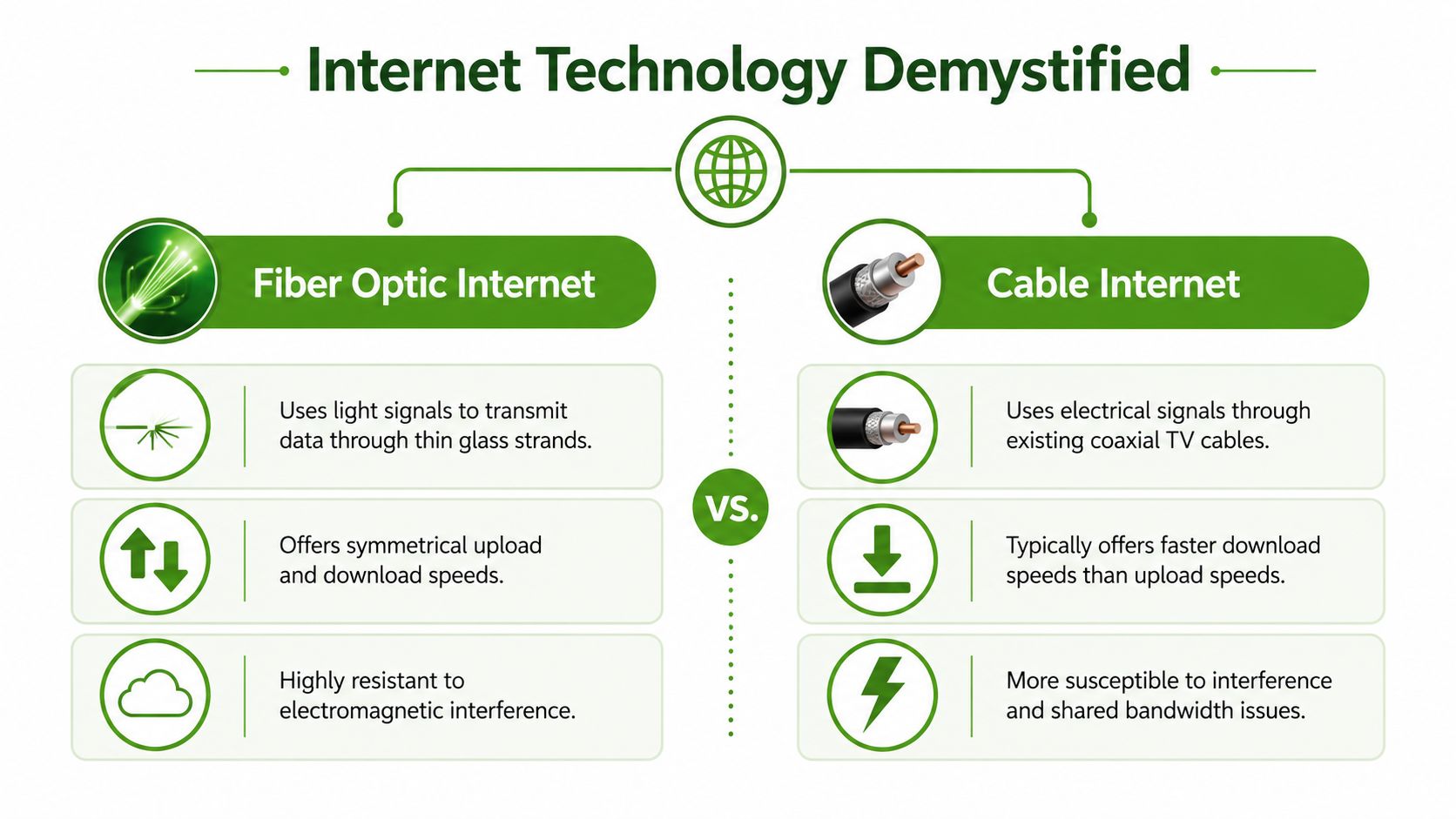
Fiber is a light-based system. Data moves through thin strands of glass as pulses of light. Cable uses electrical signals moving through coaxial copper wiring. That one difference explains most of the gap you feel in real use.
Fiber moves data differently
Light through glass is a cleaner transport method than electricity through copper. That's why fiber is built for modern workloads that need strong performance in both directions, not just when downloading content.
In Edmonton, that matters because the available plans show a major structural gap. Fiber internet delivers symmetrical speeds up to 8000 Mbps from providers like RALLY, while cable typically offers asymmetrical speeds peaking around 1 Gbps download with upload speeds capped at 10–35 Mbps, representing a 30× upload advantage for fiber in 2026 plans, according to Edmonton internet plan data from PlanHub Genius.
Cable still works, but it has limits
Cable isn't obsolete. In the right home, it can still be a perfectly usable connection for browsing, streaming, and general household use. It also benefits from existing infrastructure, which is one reason it remains common.
Its limitation is architectural. Cable plans are usually built to favour downloading over uploading. That was fine when internet use was mostly entertainment and web browsing. It's a weaker fit when a home also needs cloud storage, camera uploads, large file transfers, off-site backups, and consistent meeting performance.
An easy way to understand:
-
Fiber is built for two-way traffic.
-
Cable is built more heavily around downstream traffic.
-
Modern households now behave more like small offices than old-style TV homes.
Practical rule: Don't choose based on the headline speed alone. Choose based on how the connection behaves when you have to send data, not just receive it.
That's why people often switch to a faster cable plan and still feel disappointed. The advertised number improved, but the part of the connection causing the daily frustration didn't.
Comparing Performance Speed Latency and Reliability
Technical differences become practical realities, affecting Zoom calls, cloud sync delays, gaming responsiveness, camera feeds, and the stability of your internet during busy periods.
Fiber vs Cable Performance at a Glance
| Metric | Fiber Internet | Cable Internet |
|---|---|---|
| Download behaviour | Fast, with top Edmonton plans reaching very high tiers | Can be fast for downloads and often suits streaming well |
| Upload behaviour | Strong symmetrical performance on fibre plans | Usually much slower than download speeds |
| Latency | 3–12 ms in Edmonton, based on local comparison data | 15–30 ms in Edmonton, based on the same Edmonton latency comparison |
| Reliability | 70% fewer service interruptions per year in Edmonton, according to UAlberta student service comparison guidance | More prone to interruptions than fiber in the same local comparison |
| Best fit | Remote work, cloud use, gaming, SMB operations | General home use where budget is the main driver |
Where the Real Difference Shows Up
Download speed gets the ad copy. Upload speed decides whether remote work feels smooth or annoying.
Most comparisons miss this: for Edmonton remote workers, fiber offers symmetrical 1 Gbps uploads while cable typically caps uploads at 20–30 Mbps, which creates bottlenecks during cloud backups and video conferencing, as outlined in this Canadian fiber versus cable comparison.
That's the difference between a backup finishing quickly in the background and a backup chewing up the connection all evening. It's also why households with one person “working from home” can still struggle even when the advertised download tier looks generous.
Latency is the second part that gets overlooked. Lower latency means less delay between an action and the network response. That matters for games, voice calls, remote desktops, and any work done inside cloud-hosted systems. If you want a plain-language breakdown of why delay and variation matter, this guide to understanding latency and jitter for secure collaboration is worth reading.
For some Edmonton homes, improving the internet plan isn't the only answer. Internal wiring can also affect consistency. If parts of the house rely on older coax runs, a MoCA network adapter setup can sometimes help distribute a stronger connection inside the home without opening walls.
Reliability is the final separator. A connection that comes back quickly after a hiccup might be tolerable for casual use. It's not acceptable when invoices, backups, calls, and staff access depend on it. Fiber's lower interruption rate in Edmonton is why many home offices feel calmer on it even before anyone runs a speed test.
Availability and Plans in the Edmonton Area
The best connection on paper doesn't matter if your address can't get it. Edmonton has a mixed market. Some neighbourhoods have strong fibre availability. Others still lean heavily on coax-based cable options.
What You Can Actually Buy in Edmonton
As of 2026, the fastest available internet in Edmonton reaches 8,000 Mbps on fibre through provider RALLY, according to the CRTC communications market report. That gives Edmonton residents access to very high-end fibre tiers if they're in the right service area.
For mainstream plan shopping, the comparison often looks less dramatic but still important. The same CRTC source notes that TELUS PureFibre 1 Gbps costs $95/month with a two-year contract, while Rogers' 1.5 Gbps cable option is $85/month at promotional pricing in Edmonton.
That pricing tells you something useful. Cable can look cheaper at first glance, especially when a promo is active. Fibre may ask for a bit more each month depending on the plan and provider. The right choice depends on whether you're buying for light use or for consistency under work and multi-user load.
For budget-first shoppers, this roundup of cheapest internet plans for home helps frame what to compare beyond just the monthly number.
How to Read the Price Gap Properly
A lower monthly price isn't automatically better value. Ask these questions before you commit:
-
Is the cable price promotional? Intro pricing can change the comparison quickly once the promo ends.
-
Are you paying for headline download speed only? If your actual pain point is uploads or stability, the cheaper plan may not fix it.
-
Will the contract matter? A two-year term can be reasonable if the service fits your needs, but it's still a commitment.
A lot of Edmonton buyers focus on the top speed tier because it's easy to compare. In practice, a family or a small office usually notices connection quality more through responsiveness and consistency than through the maximum download number listed on the package.
If fibre is available at your address and your internet is part of how you earn money, store data, or support multiple users, it usually deserves serious consideration. If it isn't available, cable may still be the practical option, but then the goal shifts to choosing the least compromised plan and setting expectations properly.
Which Is Best for Your Home or Business
The best connection depends on how you use it. That sounds obvious, but it's where most plan decisions go wrong. People buy internet like they're buying a single speed number. They should be buying for workload.
Remote Worker
The remote worker usually notices upload limits first. Sending project files, syncing OneDrive or Google Drive, pushing photos to the cloud, and staying sharp on video calls all lean on upstream performance.
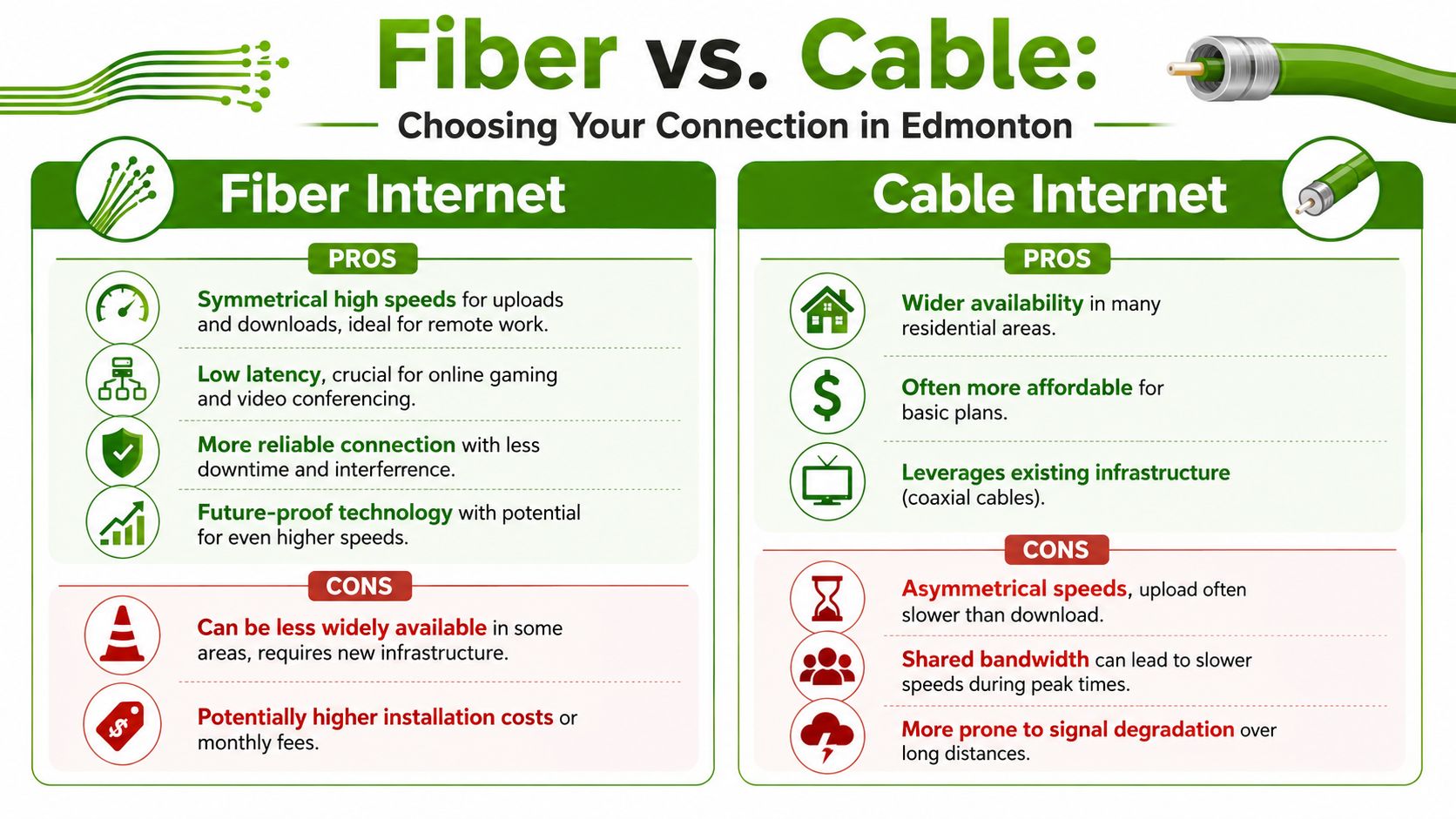
The local comparison that matters most here is simple: fiber offers symmetrical 1 Gbps uploads while cable typically caps uploads at 20–30 Mbps, which creates bottlenecks during cloud backups and video conferencing for Edmonton users, as described in this Canada-focused internet type comparison.
If your home is also your workplace, fiber is usually the right answer.
Online Gamer
Gamers often talk about speed when they really mean responsiveness. Fast downloads help with installs and updates. Lower delay matters more once the match starts.
Fiber usually gives the cleaner experience because it handles real-time traffic better. Cable can still be fine for many players, especially on a good local node and a well-configured home network, but it tends to be less forgiving when the household is busy.
If you game seriously and someone else in the house is uploading photos, backing up a laptop, or sitting in a meeting, the connection type matters more than the advertised download tier.
Busy Streaming Household
A family with several active devices can do well on either technology if the plan is matched properly. If the house mostly streams, browses, and uses smart TVs, a solid cable plan can still be enough.
Fiber makes more sense when the home has overlapping demands. A parent on Teams, a teen gaming, a TV streaming, security devices online, and a laptop syncing files can expose the weak side of cable quickly. That's when the household says “the Wi-Fi is bad,” even though the actual problem may be the internet service and upload ceiling.
Small Business
Small businesses feel internet issues differently because every interruption affects customers, staff, or billable time. Offices using cloud platforms, shared storage, remote access, VoIP, or off-site backup usually benefit most from fiber.
Nerds 2 You does not provide remote services. Nerds 2 You doesn't provide full MSP services but does provide ongoing support and network monitoring for small and medium businesses.
For an Edmonton business owner, that distinction matters because line quality and local network setup are separate problems. Even the right provider won't fix poorly placed access points, weak switching gear, or an office layout that starves staff of stable connectivity.
Cable can still work for a smaller office with lighter needs. It's just the option that requires more tolerance for compromise.
Installation Process and Future-Proofing Your Network
Once you pick the service type, the next issue is what getting connected involves. The difference between a convenient install and a durable setup then starts to matter.
What Installation Usually Looks Like
Cable is often easier to activate if the property already has live coax in place. In many homes, that means the provider can get you up and running with fewer changes. The downside is that “easy to install” and “best long-term fit” are not the same thing.
Fiber installation is often more involved at the start. A technician may need to run or activate a fibre line and place the equipment where the signal enters the building. After that, the provider equipment still has to be matched to the layout of the home or office. Router placement, access point location, and hardwired connections all matter.
A few setup checks make a big difference:
-
Place Wi‑Fi gear centrally. Fast internet at the entry point won't help much if the router is buried at one end of the house.
-
Hardwire fixed devices when possible. Desktops, TVs, and office equipment behave better on Ethernet.
-
Check old in-home wiring. Older splitters, poor coax runs, and awkward patching can create problems that look like provider issues.
For a practical walkthrough on making the inside of your network work properly, this guide on how to master your home network setup in Edmonton is useful.
Why Future-Proofing Matters More Than the Promo Rate
If you're choosing a plan for more than the next few months, future-proofing matters. National projections mention Rogers' upcoming 4 Gbps+ cable plans after DOCSIS 4.0, but local data shows many Edmonton suburban areas depend on outdated coaxial infrastructure with no clear upgrade roadmap, which makes fiber a more future-proof investment, according to this Canadian parliamentary publication on connectivity and infrastructure.
That doesn't mean cable stops working tomorrow. It means buyers should be careful about assuming every neighbourhood will get timely upgrades. If you're locking in a decision for a home office or business use, uncertainty around the local roadmap matters.
Long-view advice: Buy the connection that fits the next few years of use, not just the next invoice.
Fiber usually wins that test because the underlying technology has more room to grow and fewer built-in compromises.
Making the Right Choice and Getting Expert Setup
Most Edmonton buyers can simplify this decision quickly once they stop focusing on download speed alone. If your internet supports work, cloud backups, meetings, gaming, or several active users, fiber is usually the better fit. If your household mostly browses, streams, and keeps costs tight, cable can still be the sensible choice.
A Simple Decision Rule
Choose fiber if any of these apply:
-
You work from home regularly. Upload-heavy tasks and live calls benefit immediately.
-
You run a small business. Stability matters as much as speed.
-
You rely on cloud storage or backup. Slow upstream performance becomes a constant drag.
-
You want a longer-term solution. Fiber is the safer bet where available.
Choose cable if your situation looks more like this:
-
Your use is mostly streaming and browsing.
-
Budget matters more than best-in-class performance.
-
Fiber isn't available at your address.
-
You understand the trade-offs and can live with them.
That's the practical answer to fiber internet vs cable in Edmonton. Buy cable because it fits your usage and your address, not because the download number looks close enough on paper.
Your Internal Network Still Matters
Even the best provider plan can underperform if the internal network is sloppy. A new line comes in. The modem or ONT gets installed. Then practical challenges emerge. Weak Wi‑Fi in the back office, dead spots upstairs, old routers, poor channel settings, and unmanaged device sprawl.
That's why setup matters after the provider leaves. Home users often need router placement, Wi‑Fi tuning, device onboarding, printer access, and smart home cleanup. Small offices usually need stronger segmentation, dependable wireless coverage, backup-aware configuration, and ongoing eyes on the network.
The internet line is only one part of the result you live with every day. The rest comes from how well the equipment inside the property is installed and maintained.
If fiber is available and your connection affects income, productivity, or customer service, it's usually the right investment. If cable is the only realistic option, it can still work well when the plan is chosen carefully and the local network is set up properly.
If you need help getting your home or office network working the way it should, Nerds 2 You Edmonton can send an on-site technician to set up new internet equipment, optimise Wi‑Fi coverage, troubleshoot weak spots, and support small and medium businesses with ongoing network monitoring and practical IT help across Edmonton.
Contact Nerds 2 You for quality professional service
Experience the difference with our dedicated team of experts ready to assist you. Whether you need immediate support or have questions about our services, we are here to help. Reach out today and let us provide you with the reliable service you deserve. Your satisfaction is our priority and we guarantee a prompt response to all inquiries.
Discover more from Nerds 2 You
Subscribe to get the latest posts sent to your email.