

Your laptop is crawling, the printer has vanished from the network, and the Wi-Fi drops every time a video call starts. If you work from home, run a small office, or just want your family computer to behave, that kind of problem doesn't feel minor. It stops your day.
That's where professional computer services matter. For Edmonton homeowners and business owners, this isn't just about fixing a machine. It's about getting your time back, protecting your files, and making sure your setup supports the way you live and work now.
A lot of guides talk about on-site computer help as a nice extra. In practice, it's often the smarter choice. If your computer, router, email, and printer all have to work together in your actual space, repair quality depends on seeing that space. For modern Edmonton households and hybrid teams, the core issue isn't convenience. It's productivity.
Table of Contents
Your Tech Lifeline in Edmonton
A common Edmonton call goes like this. A home office laptop is slow, Outlook won't sync, and the Wi-Fi is fine in the kitchen but weak in the basement. Nothing is fully broken, but everything is unreliable.
For a homeowner, that's frustrating. For a small business owner, it's expensive. You lose time testing random fixes, rebooting gear, and moving cables around when you should be working.
That's why professional computer services are broader than “repair.” The job often includes diagnosing what's failing, checking how devices interact, and fixing the weak link without creating a new one. Sometimes the problem is a worn drive. Sometimes it's a software conflict. Sometimes the computer is fine and the network setup is the issue.
Practical rule: If a problem affects more than one device, app, or room, it usually isn't a simple one-part repair.
This field keeps growing because people rely on technology for nearly everything. In 2024, operating revenue for Canada's computer systems design and related services industry rose by 6.5% to reach $113.0 billion according to Statistics Canada's industry release. That tells you something useful at the ground level. More homes and businesses are paying for skilled help because trial-and-error fixes waste time.
What local help really looks like
In Edmonton, the need is usually practical, not dramatic:
-
A family desktop is slow: It starts in ages, freezes during schoolwork, and stores years of photos.
-
A new laptop needs setup: Files, email, printers, and passwords all need to move over cleanly.
-
A small office loses connection: Staff can't print, shared folders stop responding, and no one knows whether the issue is the router, switch, or computer.
-
A MacBook screen cracks: The owner needs a clear answer on parts, labour, and whether on-site service makes sense.
Good support should reduce stress, not add more of it. You should get a plain-language explanation, a sensible repair path, and a fix that suits your actual setup.
Why this matters more now
Edmonton has plenty of homes that double as workspaces. That changes the value of service. The right technician isn't just fixing one device. They're helping restore your whole working environment.
When people think clearly about computer help, they usually make better decisions. Not just faster ones.
What Are Professional Computer Services
Think of professional computer services as a doctor-and-electrician mix for your technology. A technician checks symptoms, tests likely causes, fixes what's wrong, and makes sure the system is safe and stable afterward.
That sounds broad because it is. Most computer problems fall into three practical buckets.
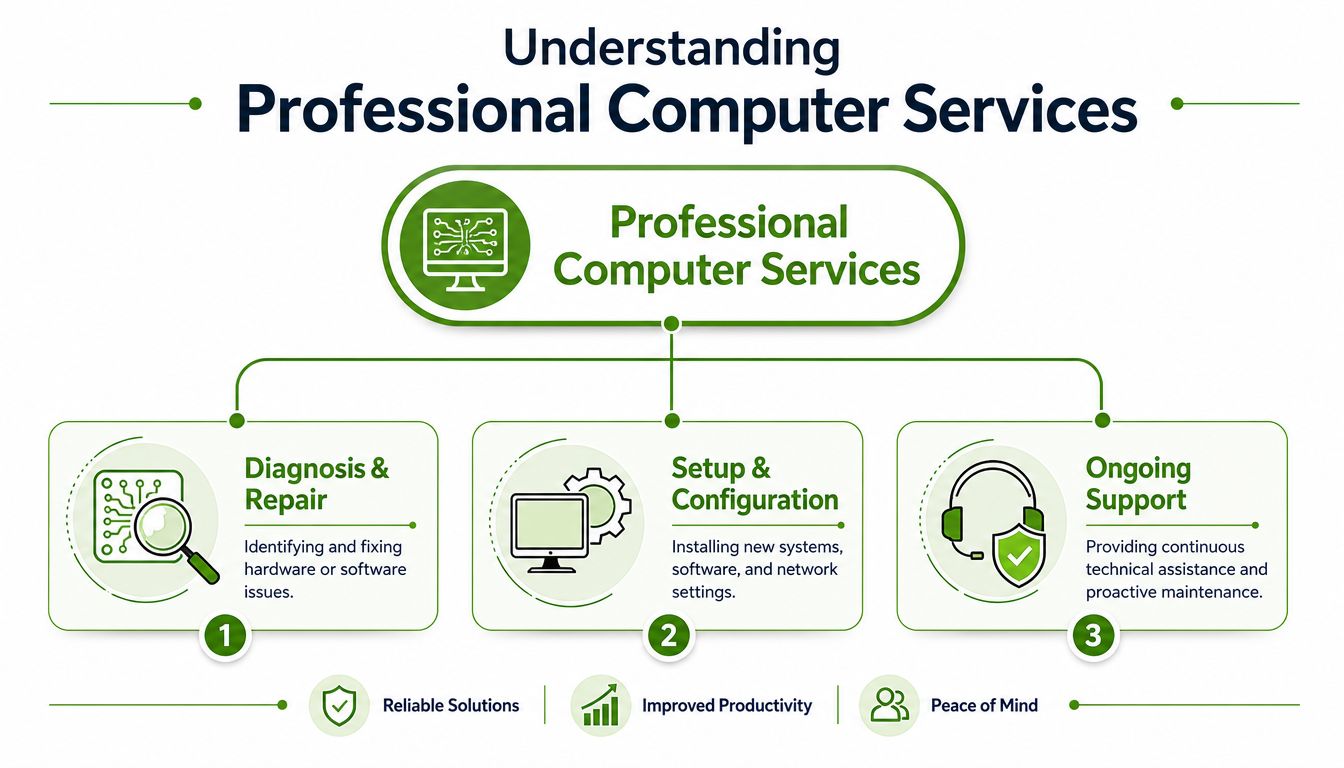
Diagnosis and repair
This is the detective work. A machine might be slow because of malware, failing hardware, bad startup settings, overheating, or a mix of smaller issues. If someone guesses wrong, they can spend money on the wrong fix.
A solid technician starts with symptoms and tests. They ask what changed, when the issue started, whether error messages appeared, and whether the problem happens all the time or only during specific tasks.
Examples include:
-
A laptop that shuts down unexpectedly: This may point to heat, power issues, or internal hardware wear.
-
A PC that feels sluggish: That can come from software clutter, storage trouble, or background processes.
-
A Mac that won't connect to Wi-Fi properly: The problem may be the computer, the router, or the network settings in between.
Setup and configuration
A lot of people only call for help when something breaks. Setup is just as important. A rushed setup often creates the “mystery problems” people live with for months.
This part of professional computer services includes installing a new computer, transferring files, connecting printers, setting up email, tuning startup items, and making sure home or office devices work together. In homes with dead spots or awkward layouts, proper network design matters just as much as the modem itself. If you're trying to improve coverage and reliability, these high-performance WiFi solutions show the kind of structured approach that helps more than buying another extender.
For readers comparing local repair options, a practical example of this service category is computer service and repair in Edmonton, where the work combines troubleshooting with setup and migration tasks.
A computer can be “new” and still be badly configured. That's why setup work often prevents later repair calls.
Ongoing support and security
Some problems don't need a one-time fix. They need regular attention. This is common in small businesses where several people share printers, files, cloud apps, and wireless access.
Ongoing support can include:
-
Routine checkups: Spotting issues before they interrupt work
-
Security help: Removing threats, improving device protection, and reducing repeat infections
-
Network stability: Watching for recurring disconnects, weak coverage, or device conflicts
For home users, this might mean occasional tune-ups and better backup habits. For a business, it can mean scheduled on-site support, practical monitoring, and someone to call before a minor issue turns into a lost workday.
Common Services for Homes and Businesses
Individuals don't search for “professional computer services” because they love the phrase. They search because something specific is going wrong. In Edmonton, the most common calls usually fit into a handful of real-world situations.
Diagnosis when a computer feels off
Sometimes a computer isn't dead. It just feels wrong. It boots slowly, spins loudly, hangs during updates, or opens apps with a long delay.
That kind of issue needs proper diagnosis first. If you replace parts before finding the cause, you can spend money and still have the same problem. A technician should test hardware health, look at software conflicts, and check whether the issue appears under load or only during certain tasks.
A homeowner might describe this as “my laptop is acting weird.” That's enough to start. Good service turns vague symptoms into a specific repair plan.
Repairs for PCs and Macs
Hardware repair is often the first thing imagined. Broken screens, bad keyboards, battery issues, charging problems, storage failures, and worn-out cooling systems all fit here.
Mac repairs deserve special mention because pricing can confuse people. Current content often skips an important local detail: Edmonton on-site Apple repairs average 15–20% higher than national averages due to limited local certified parts supply. Edmonton MacBook screen replacement costs range from $320–$410 on-site versus $275–$340 at U.S. That doesn't automatically mean mobile pricing is unfair. It often reflects local parts logistics and the realities of on-site Apple-specific work.
If you run a small software company or rely on cloud platforms, hardware repair is only one piece of your security picture. Issues in the device itself can connect to wider risks in web apps and user access. For business owners who want context on application-level testing, this overview of SaaS pentesting is a useful companion read.
Network setup and troubleshooting
Network work is where on-site service often proves its value fastest. A technician can see the modem location, wall construction, office layout, competing devices, and how people use the connection.
In newer multi-level homes, one router in the wrong spot can create dead zones upstairs or in the basement. In a small office, staff may blame the internet when the issue is really Wi-Fi congestion, device placement, or poor guest network separation.
Common network jobs include:
-
Router and Wi-Fi setup: Getting solid coverage where you work
-
Printer and device connections: Making sure every system can see the right equipment
-
Troubleshooting dropouts: Finding whether the fault is the service, the gear, or the local setup
Backup guidance and small business support
Backup help matters because many people don't notice the problem until a drive fails or a login stops working. A technician can help sort out what should be backed up, where it should live, and how to make recovery less chaotic.
Small businesses often need more than break-fix support but less than a full outsourced IT department. That middle ground is common in Edmonton. A company may need network monitoring, security help, device setup, and occasional on-site troubleshooting without handing over every IT function.
Nerds 2 You does not provide remote services. Nerds 2 You doesn't provide full MSP services but does provide ongoing support and network monitoring for small and medium businesses.
The best business support is often the kind that prevents repeat calls for the same issue.
On-Site vs Shop Repair The Real Tradeoffs
The biggest mistake people make is comparing on-site and shop repair by invoice alone. That's too narrow. A better comparison is total disruption.
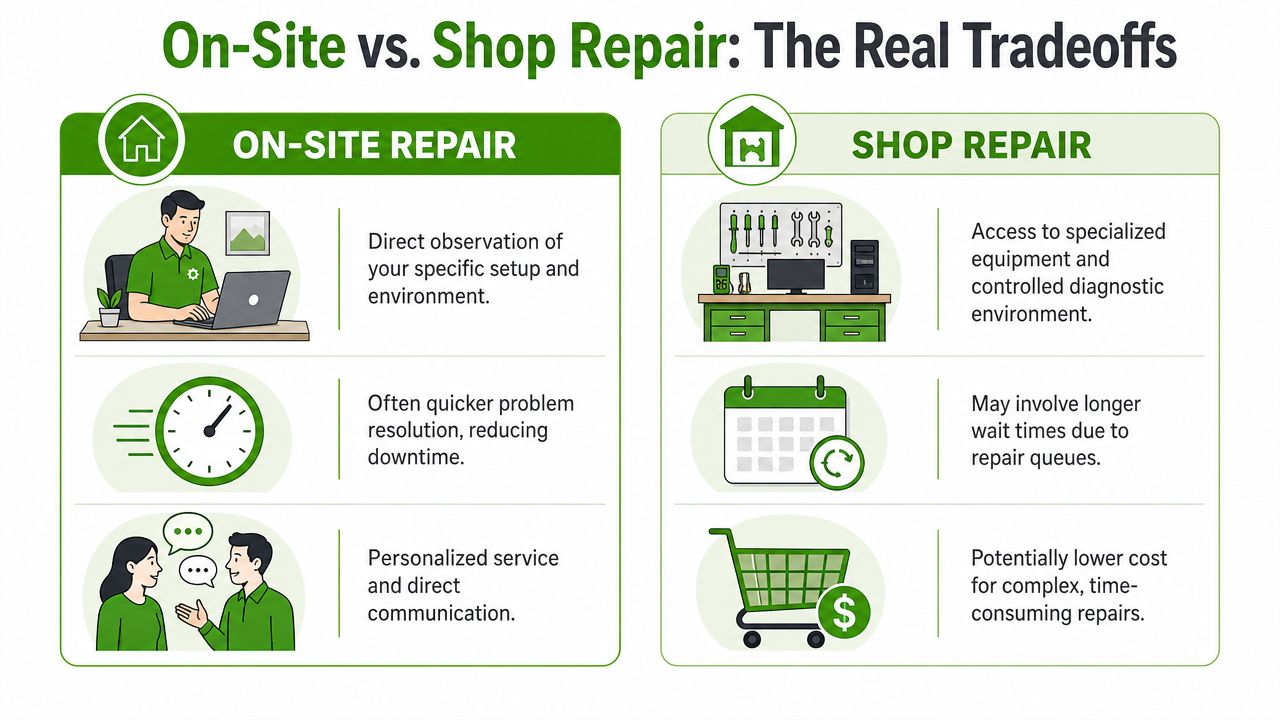
Why on-site changes the diagnosis
A shop sees the device. An on-site technician sees the environment.
That difference matters when the problem involves a router, printer, second monitor, docking station, shared drive, email setup, or weak signal in one room only. Many “computer” problems turn out to be environment problems. If the machine leaves the house or office, some of the evidence disappears with it.
On-site service also lets you show the problem as it happens. You can point to the exact outlet, the exact printer, the exact moment the Wi-Fi drops, or the exact software behavior that only happens at your desk. That often shortens the path to a useful fix.
For readers weighing what that service model includes in practical terms, this overview of on-site computer repair gives a local example of the jobs typically handled at home or in the office.
The hidden cost of waiting
The notion that “mobile is just convenience” collapses.
For a typical Edmonton SME with five remote workers, a mobile technician arriving within 2 hours saves approximately $1,850 in lost labour compared to a 6-hour shop visit window. The same source notes that Alberta businesses lose an average of 4.2 hours per unresolved IT incident, according to Generation's professional services sector page. This is the essential cost conversation.
A shop visit can trigger several layers of lost time:
| Repair model | Hidden time costs |
|---|---|
| On-site | Waiting for arrival, brief setup time, local testing in the real environment |
| Shop-based | Packing equipment, travel, intake delays, queue time, pickup, reconnecting everything, retesting at home or office |
For a remote team, one broken link can slow everyone. A shared printer issue, a network fault, or a failed workstation can ripple across the day.
On-site repair isn't only about comfort. It can protect payroll hours that disappear while people wait for systems to work again.
When a shop still makes sense
There are cases where a shop has advantages. Some complex hardware work benefits from a bench environment with specialised tools and a controlled workspace. If a machine needs extended teardown or board-level work, a shop can be practical.
But those cases don't erase the main point. If the issue depends on your real setup, your actual devices, and your working day, on-site service often gives you a better outcome with less disruption.
Security matters too. Some people prefer not to hand over a device full of family photos, tax files, business documents, or saved passwords unless it's necessary. Keeping the computer in sight can reduce anxiety and make communication easier.
Understanding Service Costs and Expectations
People often ask one direct question first. “How much will it cost?” That's fair, but the better question is “What am I paying for?”
What you're paying for
Professional computer services usually include some mix of diagnostic time, repair labour, travel, configuration work, and follow-up advice. If parts are required, those are separate from the technician's time.
The labour side reflects skilled work. Computer user support specialists earned a median annual wage of $60,340 in May 2024, while network support specialists earned $73,340, according to the U.S. Bureau of Labor Statistics occupational profile. That's a U.S. benchmark, but it still illustrates the level of technical knowledge clients are hiring when they want competent troubleshooting and network support.
A good technician isn't only turning screws. They're narrowing causes, avoiding unnecessary replacements, and reducing the chance you'll pay twice for the same unresolved issue.
What a clear estimate should include
Pricing models vary. Some tasks fit a fixed price better, such as common virus cleanup or a standard computer setup. Other jobs are naturally time-based, especially when the cause isn't obvious at the start.
Look for clarity in the quote, not just the number. A solid estimate should tell you:
-
What's included: Diagnosis, labour, travel, and basic setup or testing
-
What's extra: Replacement parts, uncommon accessories, or extended work
-
How approval works: Whether the technician will stop and confirm before adding billable repair time
-
What support follows: Basic warranty terms, revisit policy, or post-repair questions
If you manage a business connection, expectations matter as much as price. This guide to robust SLAs for business connectivity is helpful for understanding how response times and service commitments should be framed in business language.
Cheap service can become expensive if the first visit only treats symptoms and the same issue returns next week.
Transparent communication is usually the strongest sign of value. You want plain language, realistic timing, and no pressure to approve work you don't understand.
How to Choose the Right Provider in Edmonton
A provider might have a polished website and still be the wrong fit. What matters is whether they can solve your problem reliably, explain it clearly, and stand behind the work.

Canada's electronic and computer repair industry saw a 2.1% decline in the number of businesses in 2025, according to this IBISWorld industry count summary. For customers, that makes reputation and staying power more important. You want a provider that looks established, local, and reachable after the invoice is paid.
A short vetting checklist
When you compare professional computer services in Edmonton, check the basics first:
-
Local presence: Look for an Edmonton phone number, local service area, and a real Canadian web presence
-
Relevant experience: Ask whether they regularly handle PCs, Macs, home networks, printers, and small business setups
-
On-site capability: Confirm they come to you if your issue depends on your home or office environment
-
Recent reviews: Read comments on more than one platform and pay attention to how the company communicates
-
Clear service scope: Make sure they explain whether they handle one-time repair, ongoing support, or both
If you want an example of the kind of local service profile to compare against others, a personal computer specialist in Edmonton page can help you see what details should be clearly stated.
Questions worth asking before you book
Short questions can save you a lot of frustration later.
Ask things like:
-
“Do you work on this exact type of problem?” A cracked MacBook screen is different from a failing office network.
-
“Will the work be done on-site?” That matters if the issue involves printers, Wi-Fi, or multiple devices.
-
“How do you handle approval for extra work?” You don't want surprise charges.
-
“What should I prepare before the visit?” Good providers will tell you plainly.
A trustworthy technician won't hide behind jargon. If they can't explain the likely process in simple terms, that's a warning sign.
Your Pre-Service Checklist and FAQs
Good service starts before the technician knocks on the door. A little prep can shorten the visit and help protect your data.
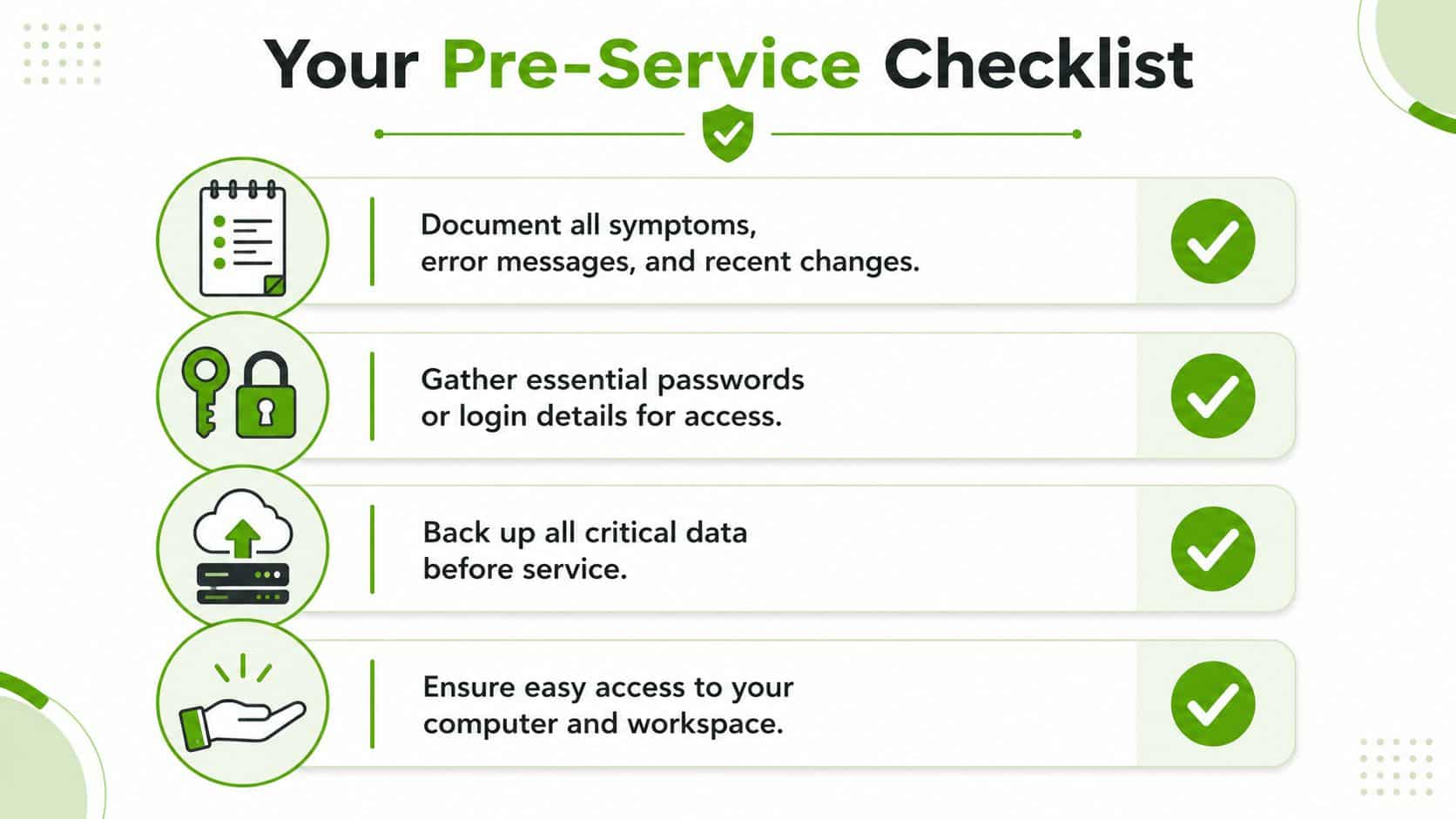
Pre-service checklist
-
Write down the symptoms: Note error messages, strange sounds, slowdowns, or what changed right before the issue started.
-
Back up important files if you can: Documents, photos, accounting files, and browser bookmarks matter most.
-
Gather key passwords: Wi-Fi, email, and computer logins may be needed to test properly.
-
Clear the workspace: Make sure the desk, tower, modem, or printer is easy to reach.
FAQs
Is my data safe during a repair?
A careful technician should work with the least invasive method first and explain any step that could affect your files.
Do repairs usually come with a warranty?
Many professional services offer some form of labour or repair warranty. Ask what's covered before work begins.
How long does a typical service call take?
It depends on the fault. Simple setup jobs can be quick. Diagnosis, parts issues, or multiple device problems take longer.
Should I try fixing it myself first?
Basic steps like restarting or checking cables are fine. If the problem is repeating, getting worse, or involves important data, guessing can make it harder to fix cleanly.
If you need on-site help with a slow computer, Wi-Fi trouble, Mac or PC repair, or small business support in Edmonton, Nerds 2 You Edmonton provides mobile computer repair and IT support for homes and offices.
Contact Nerds 2 You for quality professional service
Experience the difference with our dedicated team of experts ready to assist you. Whether you need immediate support or have questions about our services, we are here to help. Reach out today and let us provide you with the reliable service you deserve. Your satisfaction is our priority and we guarantee a prompt response to all inquiries.
Discover more from Nerds 2 You
Subscribe to get the latest posts sent to your email.