
It's a normal evening in Edmonton. You're at the kitchen table, maybe paying a supplier invoice, checking a CRA-looking text on your phone, or clearing an email that says a payment is overdue, and it feels urgent enough to deserve a quick tap.
That's exactly how phishing works. It doesn't always look like a scam from the start, it borrows trust, steals attention, and then pushes you toward one bad click, one fake login page, or one payment made to the wrong account. Canadian businesses already report phishing and spear-phishing as common cyber incidents, and APWG tracked 1,003,924 phishing attacks in Q1 2025 and 1,130,393 in Q2 2025, a rise of about 12.6% in just three months, with 30.9% of attacks in Q1 aimed at online payment and financial sectors (APWG trends reports). For a homeowner or a small shop, that means the risk isn't abstract, it's sitting inside the inbox.
Phishing attack prevention works best when you treat it like home security. One lock on the door helps, but so do the deadbolt, the motion light, the phone call before opening the door, and the habit of not assuming every knock is friendly.
Table of Contents
- Why Phishing Still Catches Edmonton Residents Off Guard
- How a Phishing Attack Actually Works
- Spotting the Red Flags Before You Click
- Technical Defences That Stop Most Attacks Before They Reach You
- Building Habits That Make a Team or Household Hard to Trick
- Your First-Hour Response Playbook After a Suspicious Click
- A 30-Day Phishing Defence Plan and Common Questions
Why Phishing Still Catches Edmonton Residents Off Guard
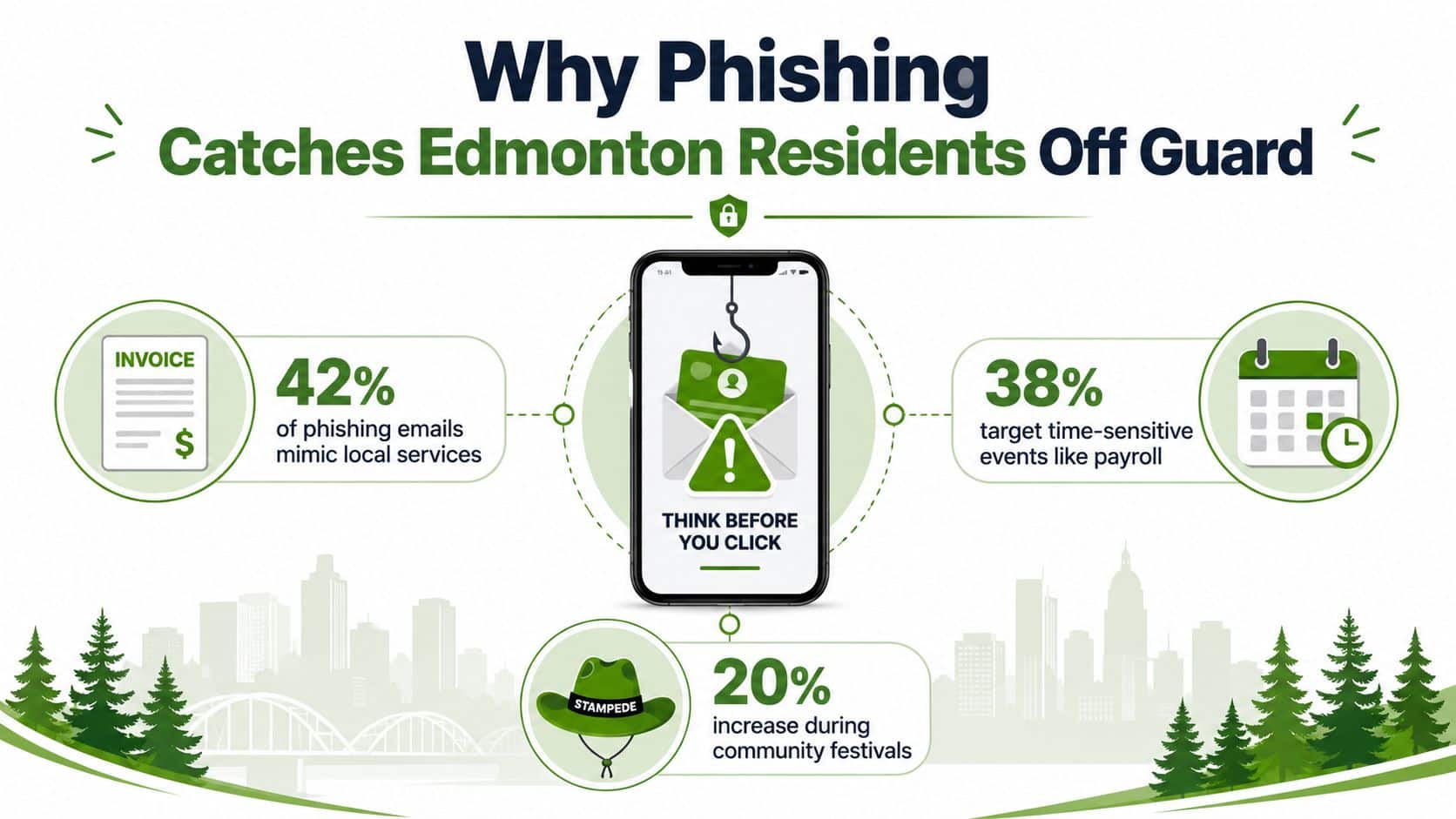
A fake CRA text during Stampede week gets past people because it feels timely. A supplier invoice email lands right before payroll because that is when someone is most likely to act fast. Phishing wins by matching your routine, then slipping in at the exact moment you are busy.
Why one bad message is never the whole story
Phishing is the delivery method, not just the message itself. It is how attackers steal logins, trigger fake invoices, and redirect transfers, which is why email authentication, payment checks, and careful URL inspection matter so much in Canadian homes and small offices. Analysts at the APWG note that attacks aimed at the online payment and financial sectors made up a large share of reported activity in their trend reports, which explains why banking, payment portals, and bookkeeping systems are such common targets (APWG trends reports).
A lot of people think they only need to avoid one suspicious email. The core issue is wider. A message can start with a fake text, continue through a copied login page, and finish with stolen credentials used somewhere else, often before the victim realises anything happened.
Practical rule: if a message pushes you to act now, pay now, or sign in now, slow down and verify through a channel you already trust.
Canadian businesses were already reporting phishing and spear-phishing as common cyber incidents in the 2022 Canadian Survey of Cyber Security and Cybercrime, so this is not a niche issue or a tech-team-only issue (CISA counter-phishing recommendations). That is why a home office, a five-person contractor, or a family managing bills from one laptop needs the same basic caution.
What the reader should remember
A phishing attack usually works because it looks normal long enough to earn a click. Once the click happens, the message stops being the main threat, and the stolen login or payment instruction becomes the problem. If you can keep that in mind, the rest of the prevention steps make sense instead of feeling random.
Read more about avoiding common computer scams
How a Phishing Attack Actually Works
Think of phishing like a forged letter that arrives with a copied letterhead and a convincing tone. The attacker doesn't need to be brilliant, they just need to get through the first few seconds of attention and make the next step feel harmless. That's why the attack usually moves through a simple funnel, lure, click, capture, cash out.
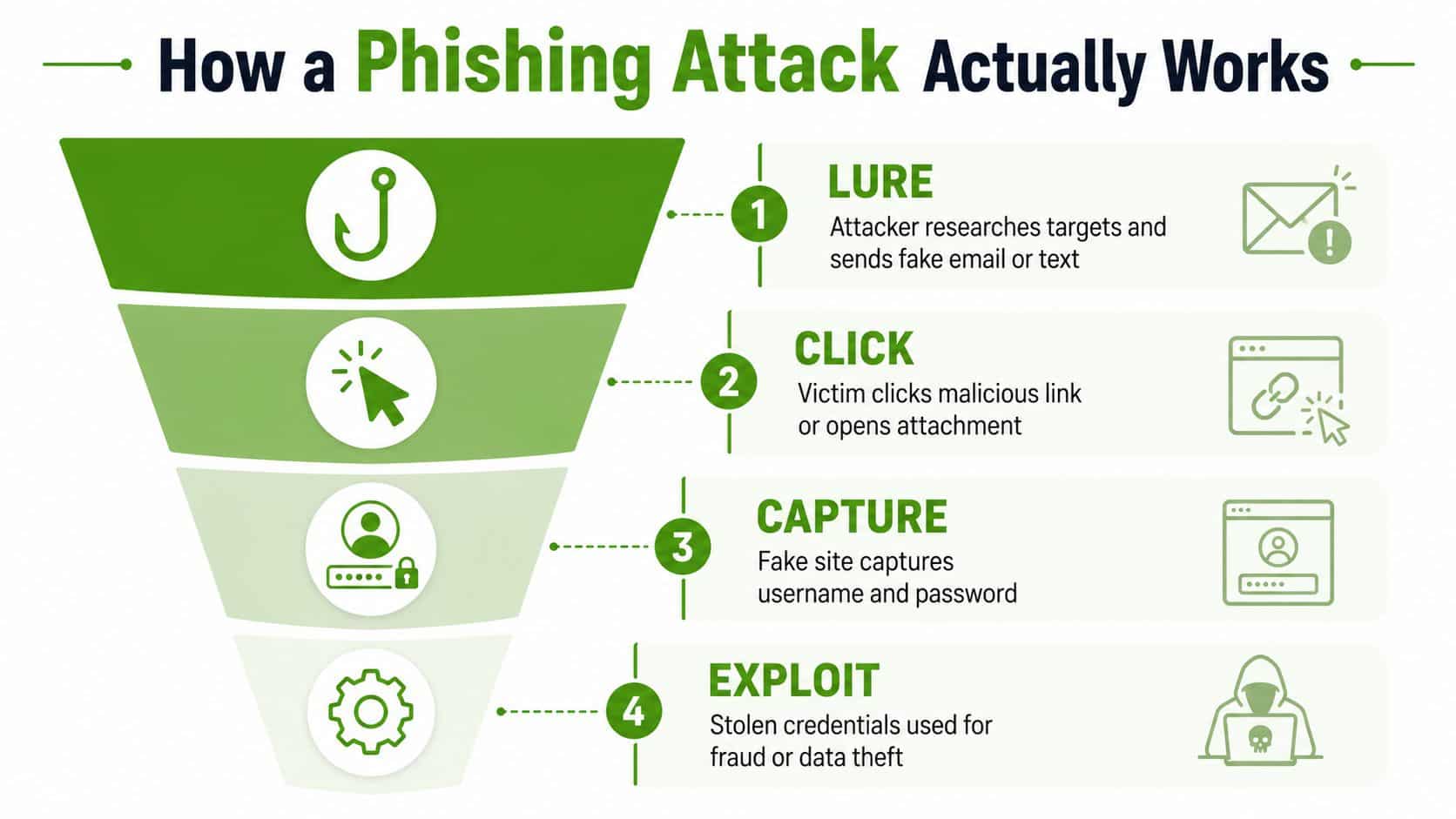
Lure and click
The lure is the message itself, maybe a delivery notice, a bank alert, a password reset, or a supplier asking for an urgent update. Microsoft notes that suspicious messages often include links or attachments, and the safer move is to open a new browser tab and go to the organisation's site from a saved favourite or a web search instead of clicking the embedded link (Microsoft phishing guidance).
The click is where the attacker gets the conversation moving. In a bulk phishing campaign, the same fake message goes to many people. In spear-phishing, the note is customized, which is why a message from a “known” vendor or colleague can be more dangerous than obvious spam. Smishing just moves the same trick to text messages, where people tend to trust the smaller screen and move faster.
Capture and cash out
The capture stage is where the fake login page collects the username and password. Once those credentials are stolen, the attacker may move to mailbox access, payment fraud, or data theft, depending on what the account can reach.
The cash out stage happens when the attacker uses the stolen access. That might mean changing payment details, setting up mailbox forwarding, sending more phishing from the victim's account, or using the account to reach other systems. CISA and the NSA both stress that the danger often grows after the initial click, which is why rapid session revocation, MFA enforcement, and mailbox-rule review matter after suspected compromise (CISA phishing guidance).
If the message is asking for a password, money, or a quick exception to normal process, assume the attacker is trying to move from lure to capture.
Spotting the Red Flags Before You Click
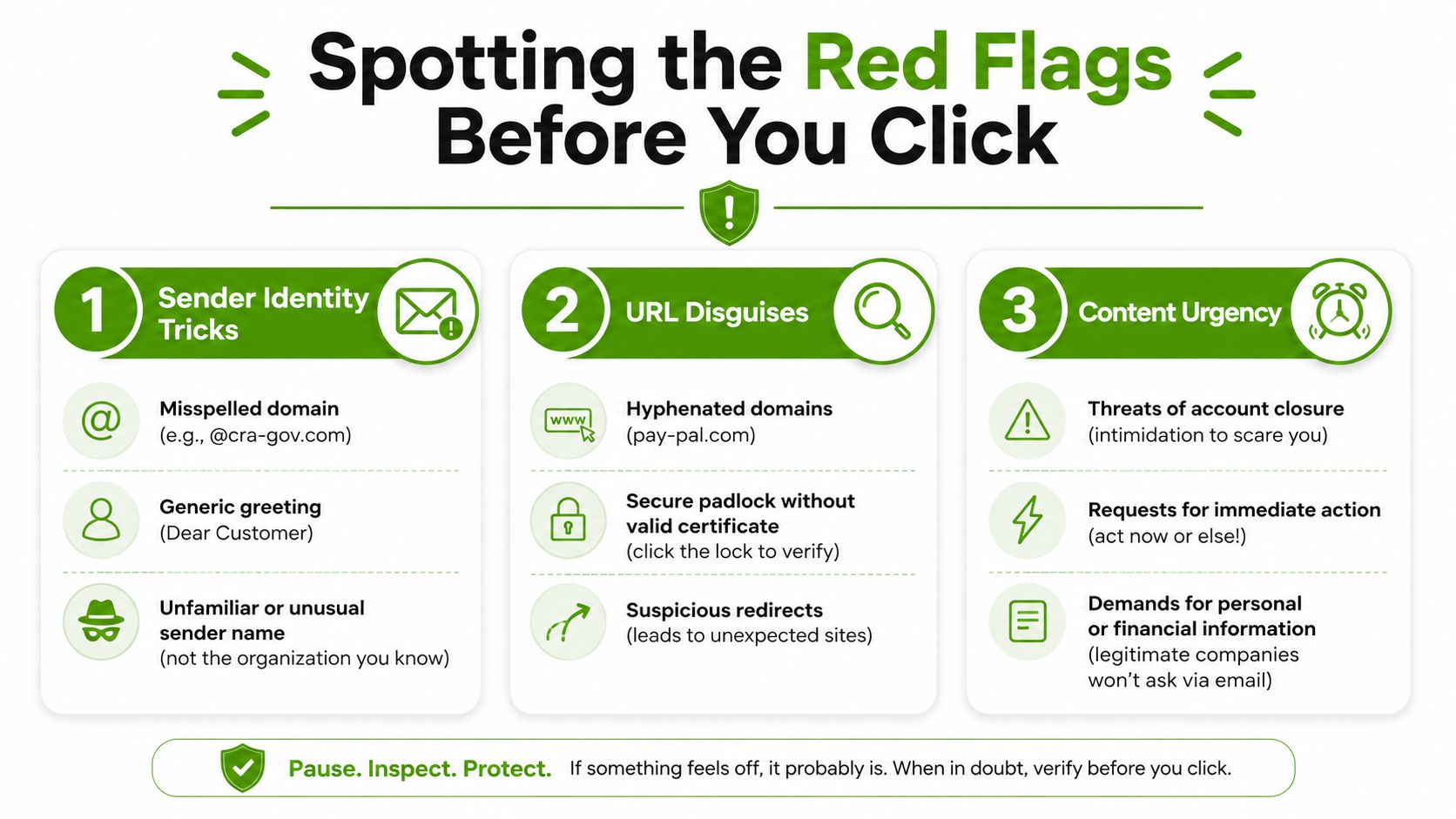
Most phishing messages give themselves away in one of three ways, sender identity tricks, URL disguises, or pressure tactics. You don't need to become a forensic analyst. You just need a short habit loop that makes you pause before your finger lands on the link.
Sender tricks and fake familiarity
The sender name can look right while the address is wrong. A missed letter, a swapped domain, or a reply-to address that doesn't match the brand is a strong warning sign. Generic greetings like “Dear Customer” or “Hello Friend” can also be a clue, but a personalised name doesn't prove safety.
If the message claims to be from your bank or a company you already deal with, use a known contact route instead of the one in the email. The OCC says not to use the phone number or link in the message, and to call the institution using the number on a monthly statement or one you independently find. It also says financial institutions would never ask you to verify account information online in response to an unsolicited request (OCC phishing attack prevention).
URL disguises and pressure language
A fake link can hide in plain sight. Microsoft recommends opening a new browser tab and going to the site from a saved favourite or a web search rather than clicking the embedded link, and that habit is especially useful when the message is attached to payment, delivery, or account changes (Microsoft phishing guidance).
Pressure language is the final red flag. “Act now”, “account closed today”, “verify immediately”, or “urgent invoice attached” are all designed to shrink your decision time. If there's an attachment you weren't expecting, stop and ask whether that file makes sense in the world before you open it.
Quick check: if the sender, the link, and the demand all arrive at the same time, treat the message as suspicious until you verify it somewhere else.
For anyone who prefers a simple rule, use this one. Don't trust the message, trust the channel you already know. If you're on a phone, call the number you already have. If you're at a computer, open the site yourself. That extra minute is often the difference between a harmless alert and a stolen login.
Technical Defences That Stop Most Attacks Before They Reach You
A careful person at the keyboard helps, but that is only one layer. A stronger inbox also needs filters, authentication, and account controls working before the message ever lands in front of the user. Small businesses often skip that setup and then expect staff to spot every fake message by hand.
The layer that keeps fake mail from looking real
Email authentication, SPF, DKIM, and DMARC, works like a stamped envelope system. It helps prove that a message really came from the sender it claims to be from, which makes spoofing harder. CISA recommends securing email gateway settings so headers and malicious content get inspected, and NCSC advises putting DMARC, SPF, and DKIM in place so attackers have a harder time impersonating your domain.
A useful companion is an allow-list email filter, especially for businesses that get a steady stream of repeat vendor mail. It lowers inbox noise by letting trusted senders through more reliably, while still leaving room for review on anything new or unusual.
MFA, patching, and endpoint protection
Multi-factor authentication is the second lock on the door. If a password is stolen, MFA can still stop an attacker from walking in with only the password. If you want a plain-language explanation you can share with family or staff, this multi-factor authentication guide keeps the idea simple.
Patching matters too. The FTC advises setting security software and operating system updates to install automatically, because timely updates reduce the chance that a phishing click turns into malware execution (FTC phishing scams guidance). Endpoint protection adds another layer by catching malicious files or behaviour after they land.
Layered phishing defences at a glance
| Layer | What It Stops | Who Can Enable It |
|---|---|---|
| DMARC, SPF, DKIM | Spoofed sender identities | Email admin or IT partner |
| Secure email gateway | Malicious headers, links, and attachments | IT partner or managed service provider |
| MFA | Stolen passwords used alone | Most users and admins |
| Automatic updates | Known vulnerabilities turning into malware | Usually the user or device owner |
| Endpoint protection | Malware after a click | User, owner, or IT partner |
Nerds 2 You Edmonton can handle on-site device checks and email setup for homes and small businesses, which makes it one practical option when inbox hardening and device cleanup both matter. The important part is not the brand choice, it is making sure the layers are in place before the next fake invoice arrives.
Building Habits That Make a Team or Household Hard to Trick
Training works best when it becomes part of the weekly routine, not a once-a-year checkbox that people forget by lunch. KnowBe4's 2026 benchmarking report found a global baseline Phish-prone Percentage of 33.2%, meaning roughly 1 in 3 employees will interact with a malicious email before any security awareness training (KnowBe4 benchmarking report). That is not a judgment on intelligence or caution. It is a reminder that repetition matters, because phishing often slips past people who are busy, tired, or trying to move quickly.
A routine people can keep
For a household or small team, short monthly refreshers are easier to follow than long annual presentations. Use one real-looking example at a time, keep the lesson plain, and tie it to a single action people can use that day. A quarterly phishing simulation gives you a safe way to see whether people still click, then you adjust the training based on what happened instead of guessing.
A reporting channel matters just as much as the lesson itself. If someone thinks they clicked, they should know exactly who to tell without worrying they will be blamed. Good security culture starts with a simple message, report fast, and we will sort it out together.
House rule: nobody shares passwords by phone, text, or email, even if the request sounds familiar.
Payment habits that prevent business email compromise
For small operators, the biggest damage often comes from payment fraud rather than an obvious virus. That is why out-of-band verification should be standard for invoices, supplier changes, and banking requests. Call the vendor using a known number, confirm the bank details outside the email thread, and keep a second person in the loop for payment changes whenever possible.
Separate duties where you can. The person who receives the invoice should not be the only person who approves the payment. If you run a very small office, even a basic second-check process can stop a rushed payment from going to the wrong account.
That same habit helps with delivery notices, customer requests, and government-looking texts. The rule stays the same, verify from a channel you already trust. The FTC's guidance on phishing scams points people toward using known contact details rather than the ones inside a suspicious message, and that fits the same payment-check habit used in small offices and homes (FTC phishing scams guidance).
A simple written process helps too. If you want a starting point, a basic incident response planning checklist can keep the steps clear when someone is under pressure.
Your First-Hour Response Playbook After a Suspicious Click
The minutes after a suspicious click can feel like standing in a kitchen with the smoke alarm chirping. People want to do something, so they close the laptop, start guessing, or try a few random fixes. A better response is slower and more orderly. Treat the first hour like a checklist, because a calm sequence does more than a flurry of panic.
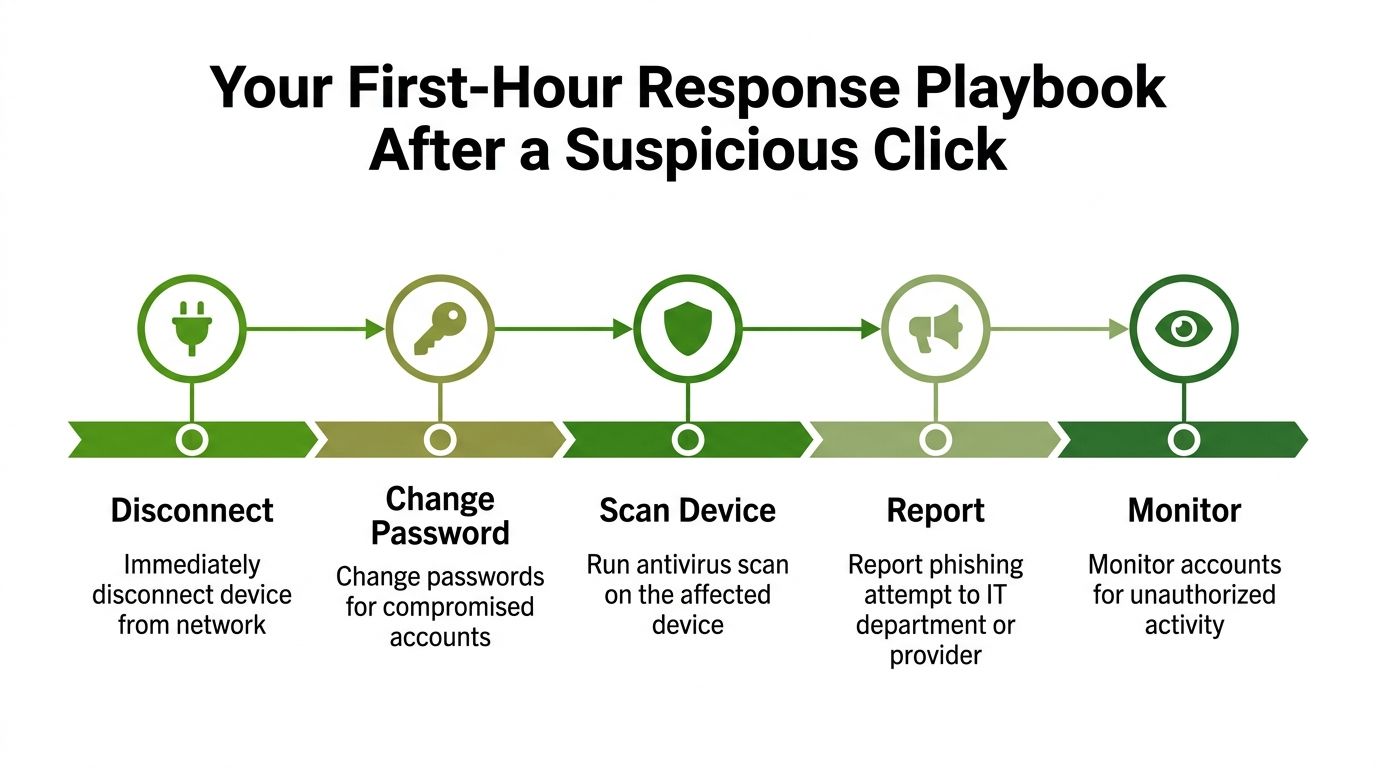
The first four moves
-
Disconnect the device. If you suspect the click opened a page or triggered a download, take the device off Wi-Fi or unplug it from the network. CISA recommends isolating affected workstations so one bad click does not spread further through the system (CISA phishing guidance).
-
Change passwords from a known-clean device. Do not reset passwords on the same device if it may be compromised. Microsoft advises changing passwords on affected accounts and turning on MFA wherever possible if an account may have been exposed (Microsoft phishing guidance).
-
Check for mailbox forwarding rules. Attackers often try to stay hidden after the first login. Review email rules and recent sign-in activity, then remove anything you did not create.
-
Call the bank using a known number. If the message was about money, use the number on your statement or another number you already trust. The OCC says never use the number in the suspicious message and never give passwords over the phone in response to an unsolicited request (OCC phishing attack prevention).
The follow-through that matters
Run a security scan on the affected device, then check whether anything else on the network looks odd. Keep the device under observation until you are sure the click did not open a wider problem. Report the message to your IT contact or provider, and if this involves business email compromise or a bank-related fraud attempt, review account activity right away.
Use this incident response planning guide if you want a simple way to organize the next steps before an incident happens. A written process helps when your head is full and your hands want to move too fast.
If money moved or credentials were exposed, call the bank first, then write down what happened while it is still fresh. Keep the sender, the time, the device used, and the action you took. That record helps the next person who has to clean up the mess.
A 30-Day Phishing Defence Plan and Common Questions
A month is enough time to make phishing attack prevention feel routine instead of overwhelming. Start with MFA on key accounts, turn on automatic updates, add email authentication where you control the domain, and make sure everyone knows how to report a suspicious message. Then run one simple phishing simulation and rehearse the first-hour response once, before you need it for real.
A workable month plan
- Week 1: Turn on multi-factor authentication for email, banking, and any admin accounts.
- Week 2: Make automatic updates active on every device you use for work or bills.
- Week 3: Ask your email admin or IT partner to set up DMARC, SPF, and DKIM where applicable.
- Week 4: Run one simulated phishing exercise and walk through the response checklist together.
If the setup feels messy, that's usually the point where outside help pays off. An on-site IT partner can check devices, help with email setup, and sort out the layers that are easy to overlook when you're juggling work and family. For Edmonton homeowners and small businesses, the practical question is whether the inbox, the device, and the account recovery steps are all covered.
Common questions
Who should you report phishing to in Canada? Use your IT contact, your provider, and the reporting options for the company or bank that was impersonated. If it's a text, the FTC says to forward it to 7726 and send phishing emails to [email protected] (FTC phishing scams guidance).
How do you tell smishing from a real delivery notice? Check whether the message asks for payment, login details, or an urgent click. Real delivery notices don't need your password, and they shouldn't force you to use the link inside the text.
Is antivirus alone enough? No. Technical controls help, but phishing still depends on stolen credentials, fake logins, and rushed decisions. That's why filters, MFA, patching, and habits all need to work together.
How often should training happen? Monthly touchpoints and regular simulations keep the lesson fresh. Long gaps make people forget the details, especially when the inbox gets busy.
Nerds 2 You Edmonton helps homeowners and small businesses with on-site computer repair, email setup, virus and malware removal, and network support that can make phishing defence less stressful to maintain. If you want a local team to help harden your inbox, review your devices, and put the right layers in place, visit Nerds 2 You Edmonton and book a conversation about what your home or office needs.
Contact Nerds 2 You for quality professional service
Experience the difference with our dedicated team of experts ready to assist you. Whether you need immediate support or have questions about our services, we are here to help. Reach out today and let us provide you with the reliable service you deserve. Your satisfaction is our priority and we guarantee a prompt response to all inquiries.
Discover more from Nerds 2 You
Subscribe to get the latest posts sent to your email.